UPDATE: Pope Leo addressed this situation at the end of his Angelus address Sunday. From Vatican News:
“I follow with concern the alarming situation in Ceuta, asking God, through the intercession of Our Lady of Africa, that solutions of peace, stability, and justice may be found.”
Pope Leo XIV made this appeal in Spanish following the recitation of the Angelus prayer on Sunday in the Vatican.
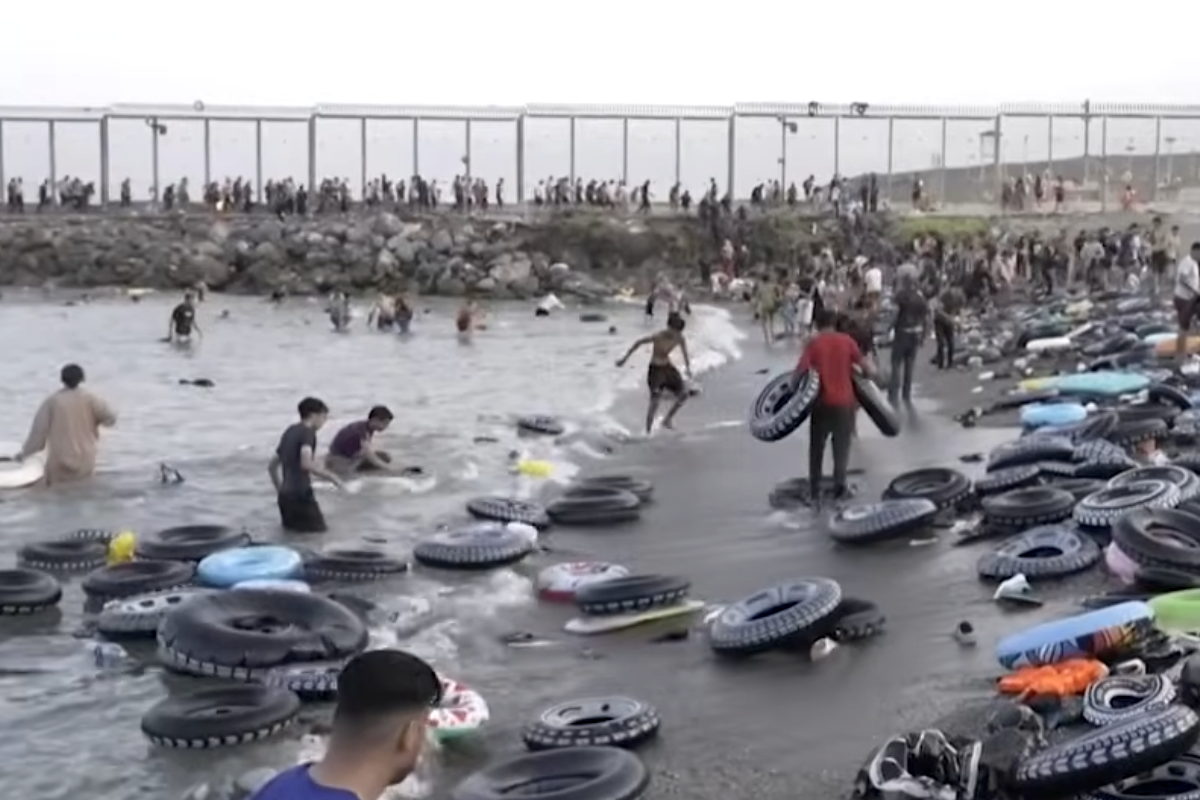
The Spanish autonomous city of Ceuta, located on the northern coast of Africa and bordering Morocco, is facing a major migration emergency.
In recent days, tens of thousands of people have attempted to enter the territory from Morocco, overwhelming reception facilities and prompting Spain to deploy additional security forces.
Amid the crisis and the dangerous attempts to cross by sea at least 67 lives have been lost. According to Reuters, most of the victims drowned at sea or were killed in crushes during the chaotic crossings.
The Pope then turned his thoughts to all those suffering because of war.
“Let us continue to pray for peace, that wars may cease throughout the world and that diplomatic solutions to conflicts may be found,” he said.
In a special way, he remembered victims of hostilities, especially “the weakest and most defenseless,” as he prayed for children, the elderly, and the sick.
Pope Leo prayed that the Lord would “comfort those who suffer and bless the work of all those who bring help and consolation.”
From EWTN:
The Catholic Church is responding to the illegal arrival within the span of just a few hours of nearly 50,000 migrants in the Spanish city of Ceuta, located on the North African coast, by mobilizing resources for the diocesan migrant ministry.
The Diocese of Cádiz and Ceuta, led by Apostolic Administrator Ramón Valdivia (auxiliary bishop of Seville), expressed in a statement its “deep concern regarding the gravity of the events and the particular vulnerability of so many people affected by this situation.”
The diocese reiterated its readiness “to collaborate with civil institutions and competent bodies” to address “any needs that may arise.”
In support of this commitment, the diocese has directed that the entirety of the collections taken up this weekend in Ceutaʼs parishes be allocated to the diocesan migrant ministry in order to channel aid through the San Antonio Migrant Care Center.
“We thank the faithful and all people of goodwill in advance for their generosity, and we invite Christian communities to pray earnestly for those who are suffering, for those responsible for managing this situation, and for all who work to build paths of peace, justice, and hope,” the statement concludes.
On social media the bishops’ Commission for Social Pastoral Care and Human Promotion of the Spanish Bishops’ Conference called for “measures addressing this situation to be taken within the framework of current law, with respect for human dignity, and avoiding manipulation for partisan ends.”
The New York Times has an explanation of what happened — some of it, evidently, was amplified by inaccurate social media posts that went viral — and indicates the surge was short-lived (gift article):
As the day progressed, it became clear many of the migrants were leaving. By the boardwalk, they hovered around Spanish soldiers who had hooked a mobile phone to stereos that played messages in Arabic telling them to go home. Other Spanish soldiers and police officers threatened the migrants, waving their sticks to push them back to the border. In town, a roving band of young Spanish men chased down and intimidated Moroccan stragglers.
Even as a sprinkling of late arrivals waded through the water, a mass return was underway.
By 6 p.m., 48,300 people had gone back across the border, according to Spain’s interior ministry. They crossed into a small beach between the countries’ border fences, its sands strewed with clothes and plastic bags, as Spanish soldiers yelled for migrants to keep moving out of Ceuta. Then they walked past iron gates topped with barbed wire and floodlights, back into Morocco.