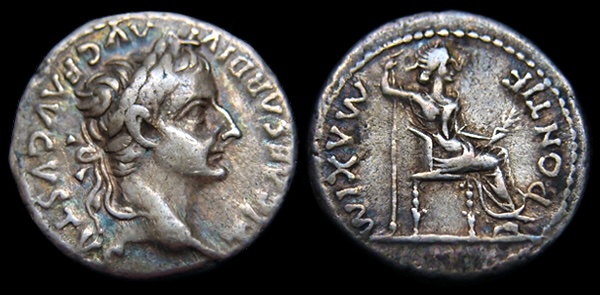
“Repay to Caesar what belongs to Caesar and to God what belongs to God.”
I can tell you: every time I drive down 429 or buy cereal at Publix or get a hamburger at Culver’s, I’m repaying Caesar. The tax gets paid.
Caesar is doing fine.
But this Gospel should make us wonder: What about God?
Are we really giving him what is due? How do we repay God? How do we even begin to measure that?
This Sunday is World Mission Sunday, when we remember and pray for and support the heroic men and women who serve the world as missionaries.
It’s worth asking: how do missionaries repay God? Some do it at great risk.
I’m thinking this weekend of a young woman from Brooklyn by the name of Ita Ford.
Ita Ford was born in Brooklyn in 1940. She attended Catholic schools and when she was a teenager she knew she wanted to be a missionary. She joined the Maryknoll order and was sent to Latin America.
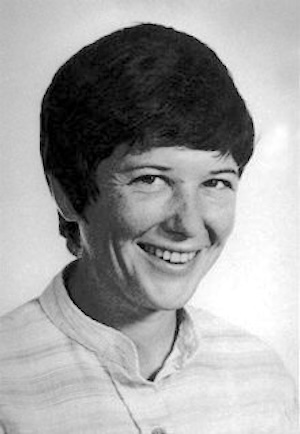
Sister Ita served for a time in Bolivia, and then in Chile, where she lived in a shanty town and ministered to the poor. In the late 1970s, she was transferred to El Salvador. The country at the time was in the middle of a brutal civil war. Sister Ita worked primarily with an emergency refugee group – providing food, shelter, transportation and faith. In a country torn by conflict and war, Sister Ita bore witness to the Prince of Peace.
In December of 1980, after a trip to Nicaragua for a regional meeting, Sister Ita and another Maryknoll sister, Maura Clarke, flew back to El Salvador. They were met at the airport by another nun, Sister Dorothy Kazel, and a lay woman named Jean Donovan.
While driving home from the airport, the four women were stopped by members of the Salvadoran National Guard. The men took the women to an isolated spot, where the women were tortured, and raped, and killed. Their bodies were found in a shallow grave about 15 miles from the airport. A U.N. commission later found that the men were acting on orders from the Salvadoran military.
The five men who did it were put on trial and sent to prison. Three of them have since been released on good behavior.
Visit almost any Maryknoll convent today and chances are you will see a picture of those women on the wall.
They are modern martyrs.
But they were also, first and foremost, missionaries.
If you want to ask how some people repay God – how some give their lives for him, for the faith, for the proclamation of the Gospel of Jesus Christ – this Sunday, World Mission Sunday, think of Ita Ford. And Maura Clarke. And Dorothy Kazel. And Jean Donovan.
Think of the countless missionaries who have crossed oceans, gone into jungles, and slept on dirt floors to bear witness and bring Christ to a hostile and unfamiliar world.
They do it with generosity. With courage.
They do it with love.
And they serve as a bold challenge to every one of us here today. Because the reality is that every one in this church right now is called to be a missionary. The word “mission” comes from “missa,” which is the same root for the word “Mass.” It means “sending.” At the end of Mass, we are sent out those doors on mission. We may not have to travel to the other side of the world. We may not face martyrdom. But we need to be willing to die to ourselves.
Just a couple weeks ago, our missionary pope, Pope Leo, posted this on social media:
“There exists a martyrdom of those who offer their lives in a single moment, and the more hidden martyrdom of those who give their lives day after day.”
He went on:
“This is exactly what all Christians are called to do: to give our lives with love, every day. Our age,” he said, “needs men and woman who have the courage to do good even when it comes at a cost. Draw close to those who are alone, seek out those who have drifted away. Doing good does not always receive recognition and often requires effort, but this is the daily courage of charity. Friendship with Jesus Christ gives us the strength to live this way.”
I would add: it gives us the passion and strength to bring Christ into the world.
In St. Augustine, Florida, there’s a big, beautiful church on the St. John’s River named San Juan del Rio, St. John of the River. Visit there and you’ll notice something surprising. As you leave the church, there is a sign hanging on the inside of every door:
“Entering the mission fields.”
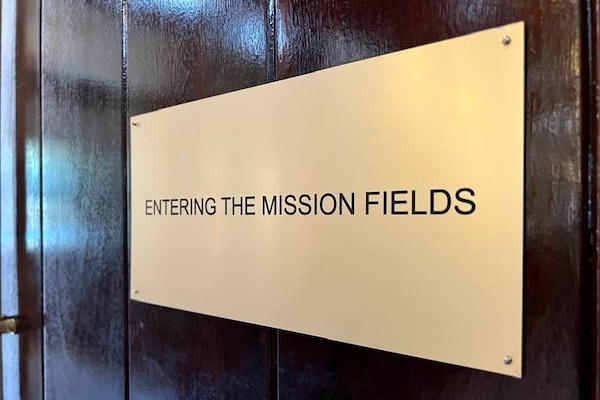
This is our calling! To be missionaries. To step into the world and change it. To exit the church, carrying Christ in our bodies and in our hearts, to make him known to the world through our actions, our lives, our love.
I go back to the question I asked at the beginning: How do we repay God?
It begins here, at Mass, worshipping the Lord we love.
But then it continues after we leave here.
We repay God every time we dry a tear, lend a hand, heal a hurt, feed someone who is hungry or give dignity to someone who has been forgotten or dismissed or marginalized.
We repay God when we welcome a stranger, visit the lonely, pray for the helpless or the hopeless.
We repay God when we seek justice in an unjust world.
“Whatever you did for the least of these, you did for me.”
That is how we live our mission, carrying Christ to others.
The pagans said of the first believers, “See how these Christians love one another.”
We might say today: See how these Christians repay their God for all the blessings he has given them.
This world, this life, is God’s gift to us.
But his greatest gift, of course, was his Son.
We can never repay God enough. But we can try.
The missionaries assigned to this parish, Father Mathew and Father Ignacio, understand that.
Sister Ita Ford understood that.
Do we?
This weekend, we thank God for missionaries – and we embrace the call each of us has to be people on mission, people of generosity and courage and love, people carrying Christ into the world.
We all do a pretty good job of repaying Caesar.
But what about repaying God?
It begins here and now.
And the great work continues out those doors.