From The New York Times (gift article)
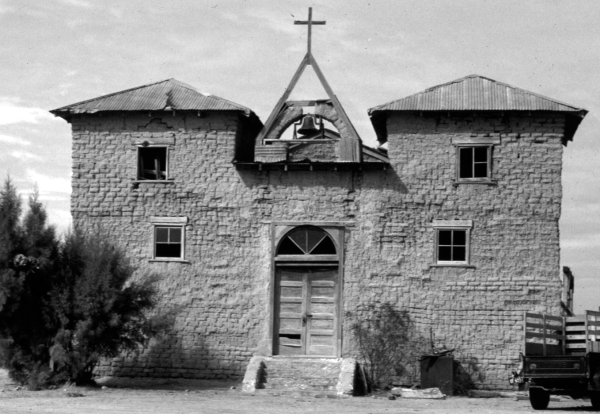
Out in Far West Texas, a heavy bronze bell once tolled, calling congregants from both sides of the U.S.-Mexico border to worship at a small adobe church.
The bell and the Catholic church in Ruidosa are hallmarks of an era when Mexican and American border communities lived as one. But nearly three generations ago, parishioners moved away from the tiny town. One of the church’s twin towers toppled. The bell disappeared.
Local volunteers have begun restoring the church, El Corazón Sagrado de la Iglesia de Jesús. They view it as one of the last vestiges of a shared history along a southwestern landscape that is as Indigenous, Spanish and Mexican as it is American. Fortifying its walls and twin towers means that perhaps the bell could ring again.
Now their work faces a new danger: President Trump’s border wall. The church is one of dozens of historical sites across the Southwest threatened by the construction. In Arizona, portions of a 1,000-year-old etching in the earth have been bulldozed. In Texas, work is endangering ancient cave murals and landmarks on the Underground Railroad.
“If you value a people’s worth and contributions, then you preserve their history in textbooks and curriculums,” the historian Trinidad Gonzales said. “You would preserve these physical markers.”
Trump administration officials say the wall will go up yards away from the church and help deter violent drug traffickers in one of the most remote parts of the Chihuahuan desert. Preservationists, though, warn that the relentless vibrations of the construction threaten the church’s fragile structural integrity.
To historians and border residents, the administration’s construction plans, alongside a campaign to deport thousands of immigrants, amount to uprooting centuries of Mexican and Latino American history and presence.
The 110-year journey of the church and its bell is a story of displacement and migration, of being lost and improbably found, and of artists, historians and community residents who have gone to great lengths to bake and haul adobe bricks, bail the bell out of a Marfa jail and reclaim a piece of lost past.
El Corazón Sagrado arose during the Mexican Revolution. Hundreds of thousands of Mexicans were migrating north. They opened schools, theaters and newspapers and, in the borderland, they organized against U.S. segregation and anti-Mexican discrimination.
In Ruidosa, a tiny settlement southwest of Marfa, the community built a church. Mexican and Mexican American families from both sides of the river molded clay bricks to raise its mission-style walls and twin towers. From a central wooden gable, they hung its bronze bell.
For nearly 40 years, the bell tolled. It brought people together for weddings, funerals and Sunday masses.
”The church was a center of life,” said Zenaida Maria Nazeri, 77, who was born in Ruidosa and attended its services.