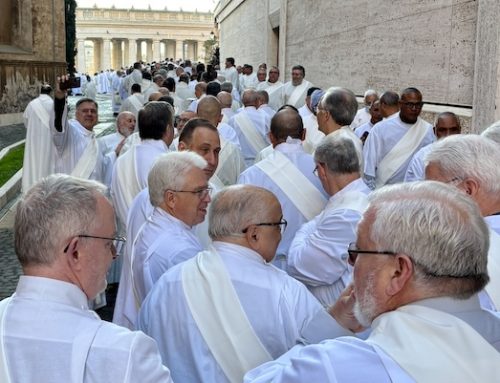

Television history will note that deacons were mentioned during Colbert’s last hurrah.
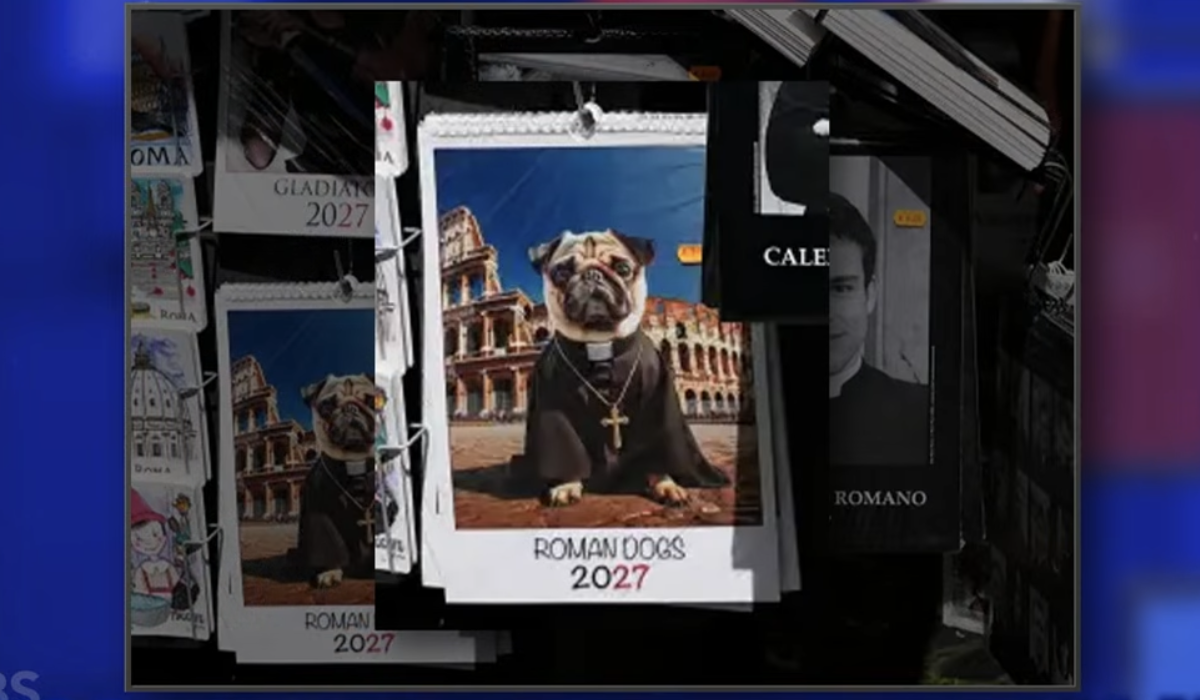
Colbert — an outspoken and very public Catholic — took note of a big Catholic story in the headlines, about the insanely popular “sexy priest” calendar that has become an annual tradition in Rome.
A calendar featuring close-ups of young, handsome men in priestly attire has been a perennial Rome souvenir for the last two decades — but few, it seems, are actually men of the cloth.
Colbert noted, sarcastically: “I’m getting word that this is the worst scandal to ever hit the Catholic Church. I’m not surprised. Just looking at them, you can tell those two men right there are clearly fake priests.”
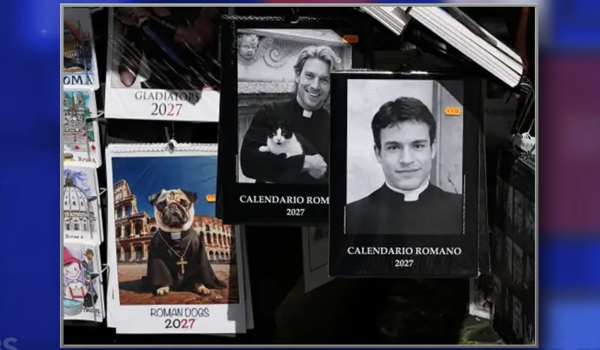
Then, he cracked: “And I know for a fact that pug is only a deacon.”
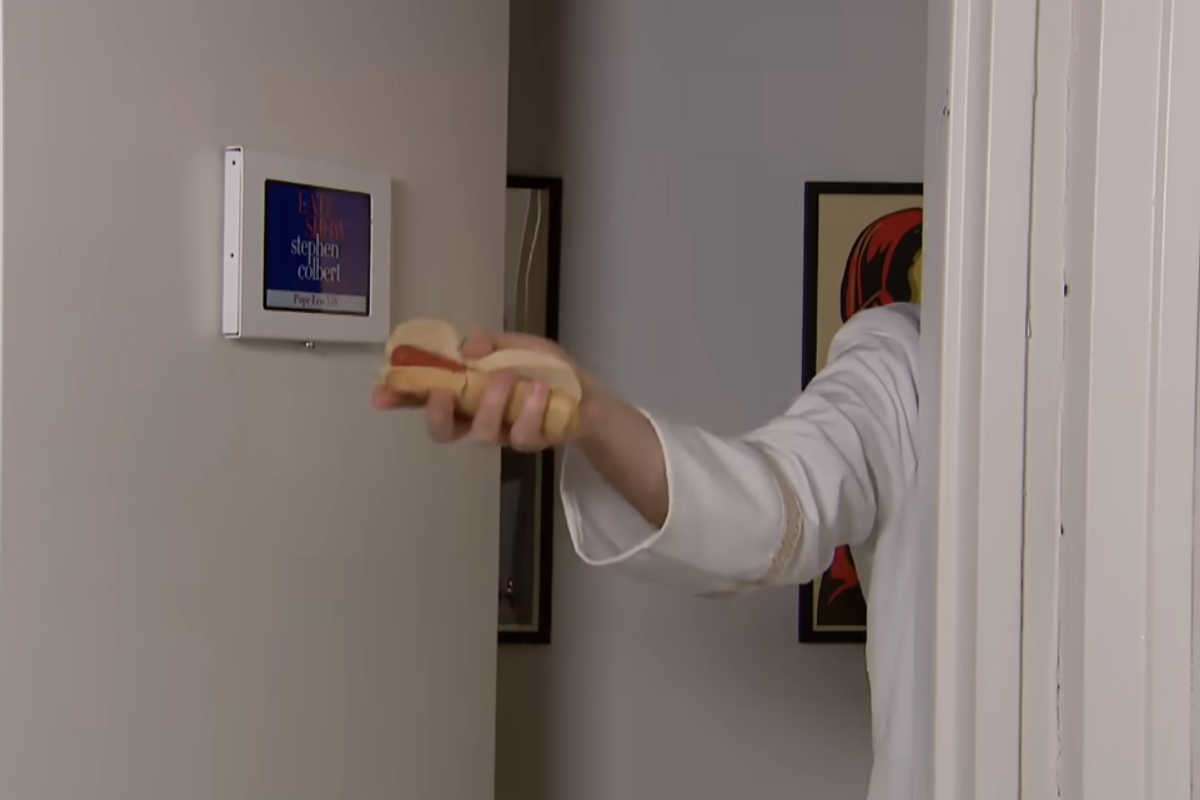
For anyone wondering: Pope Leo did not make an appearance on the show. But Colbert said he was booked and was waiting backstage — cut to a shot of a door with the pope’s name on it — but Leo refused to come on. Colbert pleaded with him. The door cracked open to show a white-sleeved arm holding a hot dog. A voice called out: “No way, Colbert. You call dat a Chicago dog? Pope don’t play like dat. Leo out!”
Seconds later, a substitute walked on stage, who just happened to be in the neighborhood: Paul McCartney, who thus became the last guest on the last Late Show — revisiting the stage where he made his historic appearance on The Ed Sullivan Show 62 years ago.
It was a perfect and sweetly sentimental ending that brought to a close a remarkable chapter in CBS history.
Former co-anchor of the CBS Evening News, John Dickerson, wrote about Colbert on his Substack this morning:
Colbert does what all performers do– thinks about what connects his work to the humans receiving it. But he goes further. He agonizes about what connects us as humans, what lifts us up, where the lines are between sentimentality and pathos, humor and cynicism, who deserves grace, who deserves a knee to the groin with a smile.
Colbert attends. He has long attended, which, when done with intention becomes an act of devotion.
Listen to Colbert talk about what should or should not go into a monologue and you’ll hear an entire worldview built over a lifetime. Quick to laugh. Quick to tears. Same porousness. Grief has sharpened his sense of joy. Beauty lands harder when you know how temporary everything is.
Gratitude is the sentiment Colbert viewers express the most. They can’t find the words exactly, so they produce them in rapid succession, the way holiday travelers trying to capture their feeling about the Acropolis take 87 photographs. None quite captures the thing, but the tonnage of snaps testifies to the depth of feeling.
For some, the gratitude has to do with politics, but that’s not the main thing. Watching someone attend on your behalf– which is what a Late Show audience experiences– creates gratitude, because the audience can feel how far back that work on their behalf has gone. This is how a person being looked at on a stage can make the audience feel like the one being seen. They leave the seats feeling like Colbert knows something about them. About love, vanity, fear, loneliness, aspiration. People see in bright lights what they had previously only felt in their bones.
To watch someone take that much care is inspiring. The Late Show crew feels it. A picture from last week at the crew party on the roof shows Colbert up on some tower talking to his staff. It looks like he’s rallying troops before a battle where they are outnumbered. The picture captures a final moment– in the future they’ll be lost, scattered– but it also captures the spirit of the 11 years that came before. Late Show staff don’t talk about their jobs like they’re members of a crew, but more like they’ve enlisted in a corps. Same throughline with the audience: they feel part of something…
…Work that is hard but reveals people to themselves is rare. How lucky to be asked to do the most that you can do. You can see it in the Late Show crew from the curb where they greet guests, threaded through the theater’s byzantine staircases, to the chair on stage, to the band and back again. You can see why. “If you love friends, you will serve your friends. If you love community, you will serve your community. If you love money, you will serve your money. And if you love only yourself, you will serve only yourself. And you will have only yourself.”4
A lot of the crew can legitimately call their boss their friend. In showbusiness this can be a nearly meaningless word, but in this case has almost a ferocity to it. Even when the odds are against the moment, Colbert’s friendship has the energy of the line, “we are horribly afraid but we are coming with you.”
Much of what has been written about the end of The Late Show has focused on how it ended. This invites a catalogue of what won’t come to an end. There are scores of people whose sense of humor, curiosity, honor and care has been drawn out of them by Colbert. That’s now all a part of their lives, their future wedding toasts, their jokes at work.
Over the years, when tragedy hit—a school shooting, an attack on the U.S. Capitol, some fresh injury to their faith in the country—people felt steadied at 11:35. They heard their fears, grief, bewilderment and convictions reflected back to them with clarity, humor and care. And there are those who take comfort at moments of intense pain from having heard Stephen talk about loss: “It’s a gift to exist,” he told Anderson Cooper in a conversation about grief, “and with existence comes suffering. There’s no escape from that. But if you are grateful for your life, then you have to be grateful for all of it.”