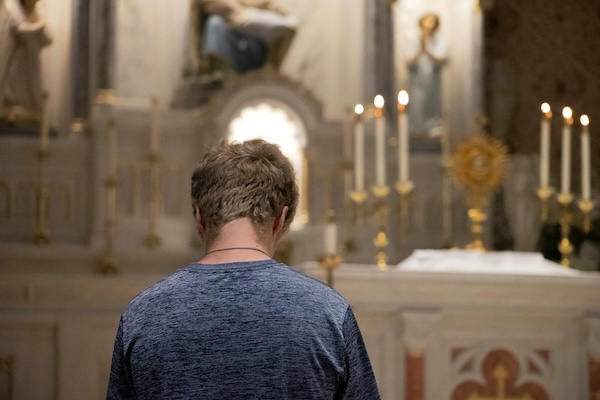
The New York Times Magazine decided to ask three young men what led them to become Catholic. What resulted is illuminating.
Reporter Zander Sherman notes:
Many of these young men felt dissatisfied with modern life and came to believe that Catholicism could offer a meaningful alternative — which may help explain why some are seeking out a more traditionalist form of the faith than is typical among Catholics.
Here’s one of the interviews:
My father’s a linguist, so he spent a lot of time overseas studying ancient languages, and my parents converted from Catholicism to Hinduism before I was born. But when I was growing up, we would still gather for Christmas at the house of my great-great-grandfather, who was a Catholic, and then attend midnight Mass. After he died, we stopped going to Mass. I eventually wondered, What had sustained his faith for so many years?
As I got older, I got married and found a good job in tech. In my mid-20s, my wife and I began identifying the usual goals: make money, buy a house. But as we were talking, we realized those ambitions lacked a foundation. We knew what we wanted to accomplish but not why. I felt I was in a real period of malaise. It felt like culture and society don’t define what a good life is outside of shallow catchphrases. My wife, who was raised Baptist but had sort of fallen away from it, suggested that we start going to church.
So we started researching different Christian denominations online. We’d prompt ChatGPT with questions like, “Give me the five best arguments for and against double predestination,” which is part of Calvinism. Then we’d compare those against the arguments of earlier writers and thinkers. We were trying to figure things out, because an incredible amount had been written and argued over the last 1,900 years.
We’d gradually rule things out: We weren’t Calvinists. We weren’t Episcopalians. That was genuinely what it came down to. In some denominations, if someone like Saddam Hussein, right at the end of his life, said, “I believe in Jesus Christ,” he would be saved. But Catholics believe in works; what matters is not merely that we believe but that we strive to love rightly and live according to God’s will. We were ultimately convinced by that emphasis on personal agency.
I would say of the young men under 30 that I work with at my tech company, maybe 30 percent are Catholic. Two converted or are in the process of converting. Some are returning to the Catholic faith that they were raised in. What’s noteworthy to me is the extent to which people are far more open about it.
I think some Gen Z men may be returning to something my great-great-grandfather understood: There’s a peace that comes from worship. He embodied a more traditional sense of morality that was more objective and was less flexible to the moment.