
Some news out of Rome that has nothing to do with the Synod, via CNS:
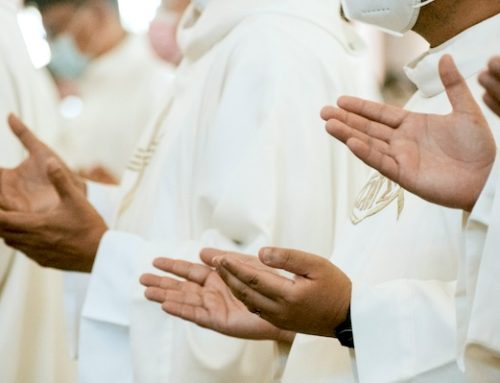
Before the Altar of the Chair in St. Peter’s Basilica, a symbol of the Catholic Church’s unity behind the successor of St. Peter, 15 men laid prostrate to express their humility and take vows of chastity and obedience to their bishop.
But despite the ornate setting and the throngs of family and friends, “it’s not about you,” Archbishop Alexander K. Sample of Portland, Oregon, told the candidates from 13 U.S. dioceses seated before him Oct. 3. “First and foremost, it’s about servanthood, it’s about service to the people of God and to Christ the Lord.”
“The symbolism of laying flat on the ground is the complete surrender of your life to Jesus,” he said in his homily. “We worry about all kinds of things in the world today, in the church and in the world. Jesus has got this, he’s got you.”
U.S. Cardinals James Harvey, archpriest of Rome’s Basilica of St. Paul Outside the Walls, and Edwin F. O’Brien, retired grand master of the Equestrian Order of the Holy Sepulchre of Jerusalem, attended the Mass for the ordination of the men studying at the Pontifical North American College in Rome. Eight other U.S. bishops concelebrated the Mass.
In his homily, Archbishop Sample noted that in the Gospels the apostles are occasionally depicted as arguing about who is the greatest among them, earning admonition from Jesus who did “not come to be served, but to serve.”
“This is the image that you take upon yourselves today” by becoming deacons, he said. “You are taking on the identity of Christ who comes to serve, to be a slave, to lay down his life as a ransom for the world.”
While many people may ask what tasks a deacon can perform, Archbishop Sample said in his homily, a deacon is defined by his identity as “an icon of Christ.”
He said that even as the newly ordained deacons continue into the priesthood, “you will always be a deacon,” noting how the College of Cardinals has cardinal deacons and how a priest would serve as a deacon at a high Mass celebrated in the Traditional Rite. Additionally, a bishop wears a dalmatic, the traditional vestment of a deacon, under his priestly vestments on certain occasions “to be reminded that he is always a servant, as you will be always a servant.”