Reporting on this story has poured in from around the country. Here’s a sampling.
From The New York Times:
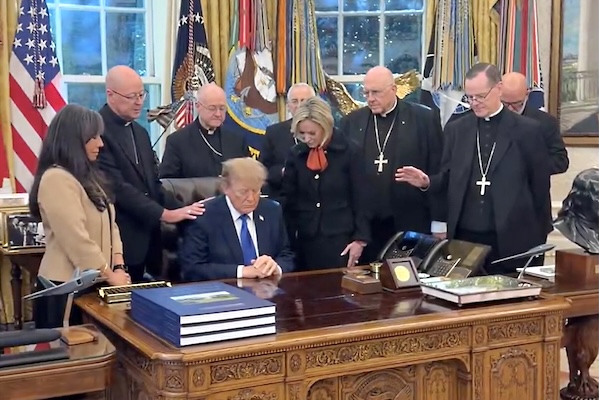
Catholic leaders say meeting with Trump wasn’t intended to be political. The video, not even 30 seconds long, showed several Roman Catholic bishops praying with President Trump last week in the Oval Office. That footage, shared on social media by a White House official during the thick of election season, blazed across the internet and became entangled in the fractured politics of the country and the church…
From AP:
Two Catholic bishops have expressed regret about agreeing to a White House meeting that produced a publicly distributed photo of them praying with President Donald Trump.
Milwaukee Archbishop Jeffrey Grob, in a statement titled “A Public Apology,” said Sunday that he had received many questions and comments — some of them distraught — about the meeting on Thursday which he and 11 other bishops attended…
From EWTN, some added context:
A spokesperson for Diocese of Gallup, New Mexico’s Bishop James Wall told EWTN News that “Bishop Wall does want to express that he would accept a meeting with any politician, if invited, to discuss important church matters, regardless of the time of year and the political party, and that he offers prayers for all who hold political office, that they lead with integrity and not division.”
The office of Archbishop Emeritus Joseph Naumann, who led the Archdiocese of Kansas City before retirement, also released a statement indicating that during the meeting the prelate voiced concerns about chemical abortion and IVF, while advocating for pro-life reproductive health care. He also discussed religious liberty, immigration, school choice, and protecting children from pornography…
From OSV News:
Multiple U.S. bishops who attended an Oval Office meeting with President Donald Trump less than two weeks before the midterm elections offered their regrets after a video taken of the meeting circulated by the White House sparked controversy.
Critics said the video, showing a dozen Catholic bishops praying over Trump on Oct. 22 risked creating the appearance of an endorsement shortly before the midterm elections…
From RNS:
The White House did not directly respond to questions about the bishops’ suggestion that they were manipulated by White House staff. Instead, officials sent along a statement from White House spokesperson Taylor Rogers, who wrote, “There has never been a greater president for Catholic Americans than President Trump,” citing examples such as the administration’s opposition to gender-affirming care for transgender children and the president’s decision to pardon activists convicted for blockading abortion clinic entrances…
OSV also offers this analysis:
John White, a professor of politics at The Catholic University of America in Washington, told OSV News that a video circulated by the White House of the meeting showing the bishops praying over Trump, so close to the Nov. 3 elections, risks creating the appearance of a “tacit endorsement.” But he called it “notable” that a number of bishops distanced themselves from the meeting through more official channels.
Kevin Appleby, senior fellow for policy and communications at the Center for Migration Studies of New York and the former director of migration policy for the USCCB, told OSV News that he hopes the bishops in attendance had the opportunity to express concern about “the treatment of immigrants, especially the separation of families and the detention of children and pregnant women.”
Appleby also pointed to a lawsuit earlier in October filed by the Archdiocese of St. Louis against the federal government over a policy it said prohibits priests from distributing Communion and hearing confessions to people detained by U.S. Immigration and Customs Enforcement for alleged immigration-related violations.
White House Faith Director Jenny Korn wrote in a post on X that the meeting included discussions “on religious freedom, school choice, family tax credits, religious visas, and life,” and rejected characterization of the meeting as a “photo op.”
“They are leaders within their communities and have a seat at the table,” she said.