

So, on Wednesday I visited Quest Diagnostics to have blood drawn for my first PSA test following my cancer surgery.
This is a big deal, since it can measure the operation’s relative success. If the PSA shows a measurable amount of cancer still remaining, that’s a problem.
This morning, before I’d even gotten out of bed, I got an email from Quest. I clicked it open on my phone and logged onto my patient portal and read this:
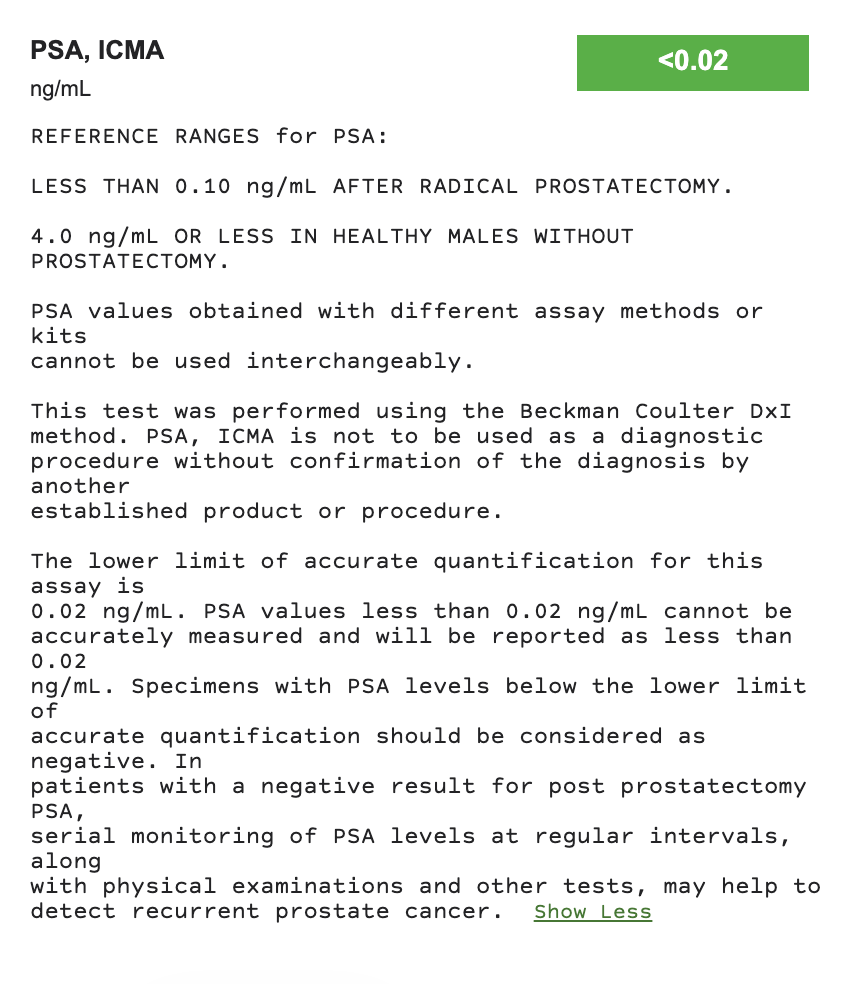
What mattered the most to me was this phrase:
“Specimens with PSA levels below the lower limit of accurate quantification should be considered negative.”
My measurement is below 0.02, which qualifies, in cancer-speak, as “negative” or “undetectable.”
The Prostate Cancer Foundation notes:
If you have had a prostatectomy and your PSA is undetectable, that’s wonderful–but don’t stop getting it checked. “Some men may think, ‘my surgery’s done, I got my path report, there are negative margins, so that means there’s no cancer left,’” says Weill Cornell Medicine urologist Jim C. Hu, M.D., M.P.H. And often, this is true.“I’ve seen instances where men go ‘off the wagon,’ don’t get their follow-up PSAs for a couple of years.”But they may not be out of the woods. Of the men who develop a recurrence of PSA after prostatectomy, 50 percent experience it more than three years after surgery, and 70 percent have it within five years. In other words, most recurrences happen within 5 years after surgery. After 10 years, the risk of a PSA recurrence becomes very low–but it’s still possible, and this is why many urologists advise their patients to keep getting the PSA checked for decades.
All I can say for now is: thank God. And my doctor. And all my prayer warriors. For now, I may not be completely out of the woods, but I have both feet in the sunlight. The world looks more promising than ever.
Let there be light.