UPDATE: The cardinals (note story below) aren’t the only ones speaking up about this. So is the Archbishop of the Military Services:
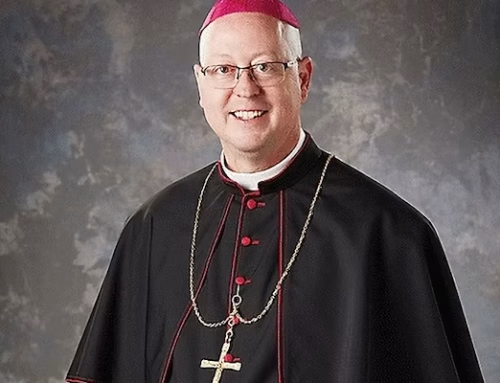
The Archbishop of the Military Services said that Trump administration’s threat to attack the territory ‘tarnishes the image of the United States in our world’.
Catholic personnel in the US military could in good conscience consider disobeying orders to attack Greenland, according to the bishop responsible for their pastoral care.
The Archbishop of the Military Services Timothy Broglio said personnel “could be put in a situation where they’re being ordered to do something that’s morally questionable” if the US acted on President Donald Trump’s threats of military action to take control of Greenland.
Speaking on the BBC’s Sunday programme on 18 January, Archbishop Broglio said it would be “very difficult for a soldier or a marine or a sailor by himself to disobey an order such as that”, but “within the realm of their own conscience it would be morally acceptable to disobey”.
Meanwhile, from The New York Times:
The three highest-ranking Roman Catholic clerics who lead archdioceses in the United States said in a strongly worded statement on Monday that America’s “moral role in confronting evil around the world” is in question for the first time in decades. Their critique of the Trump administration’s principles — while not mentioning President Trump by name — escalates the American Catholic Church’s denunciations of the country’s top leaders.
In 2026, the country has entered “the most profound and searing debate about the moral foundation for America’s actions in the world since the end of the Cold War,” read the unusual statement issued by Cardinal Blase Cupich, archbishop of Chicago; Cardinal Robert McElroy, archbishop of Washington; and Cardinal Joseph Tobin, archbishop of Newark.
Citing recent events in Venezuela, Ukraine and Greenland as having raised fundamental questions about the use of military force, the cardinals call for a “genuinely moral foreign policy” in which “military action must be seen only as a last resort in extreme situations, not a normal instrument of national policy.”
The cardinals did not delve into policy details, and declined to offer specifics about the countries mentioned in the statement. They specifically frame their statement as a message larger than partisan categories. But the context is clear. The president has threatened to take over Greenland “the hard way.” In Venezuela, the Trump administration has ordered U.S. troops to attack boats it says traffic in narcotics, and U.S. forces captured and extracted President Nicolás Maduro and his wife without authorization by Congress.
Pope Leo XIV has emphasized Venezuela’s “sovereignty” and has called for dialogue over violence. He has also repeatedly called for peace in Ukraine, and said President Trump’s peace plan would bring a “huge change” in the alliance between Europe and the United States.
In interviews and in their statement, the American cardinals expressed concern about the rise of a global order based on force and domination rather than one based on peace and freedom.
“The post-World War II consensus of dialogue among nations, the sovereign rights of countries, the refusal to use war to pursue questions of national dominance and national gain — that consensus is shifting away now,” Cardinal McElroy said in an interview. He was appointed by Pope Francis to the influential role of archbishop of Washington just weeks before President Trump’s second inauguration in 2025.
The cardinals’ statement was inspired in part by conversations the three men had earlier this month in Rome, at a closed-door gathering to which Pope Leo had summoned all cardinals around the world.
Read it all (gift article)
America magazine has posted the entire statement on its website:
Charting A Moral Vision of American Foreign Policy
In 2026, the United States has entered into the most profound and searing debate about the moral foundation for America’s actions in the world since the end of the Cold War. The events in Venezuela, Ukraine and Greenland have raised basic questions about the use of military force and the meaning of peace. The sovereign rights of nations to self-determination appear all too fragile in a world of ever greater conflagrations. The balancing of national interest with the common good is being framed within starkly polarized terms. Our country’s moral role in confronting evil around the world, sustaining the right to life and human dignity, and supporting religious liberty are all under examination. And the building of just and sustainable peace, so crucial to humanity’s well-being now and in the future, is being reduced to partisan categories that encourage polarization and destructive policies.
For all of these reasons, the contribution of Pope Leo in outlining a truly moral foundation for international relations to the Vatican diplomatic corps this month has provided us an enduring ethical compass for establishing the pathway for American foreign policy in the coming years.
He stated:
In our time, the weakness of multilateralism is a particular cause for concern at the international level. A diplomacy that promotes dialogue and seeks consensus among all parties is being replaced by a diplomacy based on force, by either individuals or groups of allies. War is back in vogue and a zeal for war is spreading. The principle established after the Second World War, which prohibited nations from using force to violate the borders of others, has been completely undermined. Peace is no longer sought as a gift and desirable good in itself, or in pursuit of “the establishment of the ordered universe willed by God with a more perfect form of justice among men and women.” Instead, peace is sought through weapons as a condition for asserting one’s own dominion.
Pope Leo also reiterates Catholic teaching that “the protection of the right to life constitutes the indispensable foundation for every other human right” and that abortion and euthanasia are destructive of that right. He points to the need for international aid to safeguard the most central elements of human dignity, which are under assault because of the movement by wealthy nations to reduce or eliminate their contributions to humanitarian foreign assistance programs. Finally, the Holy Father points to the increasing violations of conscience and religious freedom in the name of an ideological or religious purity that crushes freedom itself.
As pastors and citizens, we embrace this vision for the establishment of a genuinely moral foreign policy for our nation. We seek to build a truly just and lasting peace, that peace which Jesus proclaimed in the Gospel. We renounce war as an instrument for narrow national interests and proclaim that military action must be seen only as a last resort in extreme situations, not a normal instrument of national policy. We seek a foreign policy that respects and advances the right to human life, religious liberty, and the enhancement of human dignity throughout the world, especially through economic assistance.
Our nation’s debate on the moral foundation for American policy is beset by polarization, partisanship, and narrow economic and social interests. Pope Leo has given us the prism through which to raise it to a much higher level. We will preach, teach, and advocate in the coming months to make that higher level possible.
Signed,
Cardinal Blase J. Cupich, Archbishop of Chicago
Cardinal Robert W. McElroy, Archbishop of Washington
Cardinal Joseph W. Tobin, C.Ss.R., Archbishop of Newark