From NBC News in Boston:
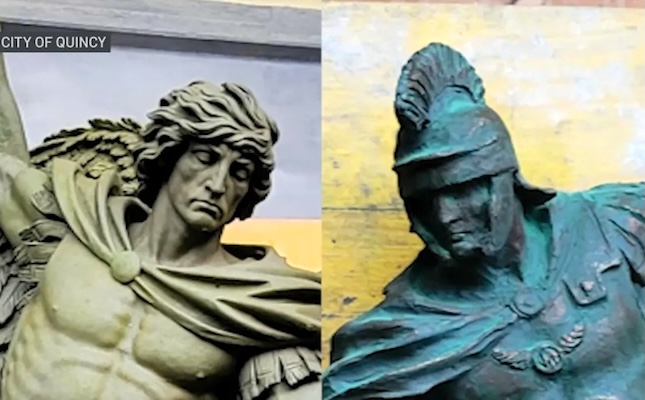
The Becket Fund for Religious Liberty, a prominent legal group that’s argued before the Supreme Court, is joining the planned appeal from the city of Quincy, Massachusetts, over statues of Catholic saints it seeks to install on the city’s new public safety headquarters.
Last week, a Norfolk Superior Court judge ordered that Quincy pause the project while a lawsuit filed by a group of taxpayers, backed by the American Civil Liberties Union of Massachusetts, makes its way through court.
The group sued in May, citing the separation of church and state. Legal arguments were heard last month regarding the city’s use and financing of religious symbols for a city-owned building, and Judge William Sullivan invoked the name of Quincy’s favorite son, Founding Father and U.S. president John Adams, at the hearing and in the subsequent order, which said the lawsuit is pursuing “the religious neutrality Article 3 [of Massachusetts’ Constitution] guarantees.”
But the city insists the figures of St. Michael the Archangel and St. Florian commissioned for the new public safety headquarters have been used by police and fire departments, respectively, as symbols of professional ideals.
“We respect every citizen’s beliefs, religious or not. But the statues of Michael and Florian honor service–not a creed,” Mayor Thomas Koch said in a statement shared by the Becket Fund for Religious Liberty. “We’re hopeful that the court will reverse this order and allow our city to pay tribute to the men and women who keep our city safe.”
The ACLU’s website reported on this a couple weeks ago:
The lawsuit was brought in May by a multifaith group of Quincy residents, who argue that the plan violates the separation of church and state, as codified in the Massachusetts Constitution. The plaintiffs are represented by the American Civil Liberties Union of Massachusetts, the ACLU, Americans United for Separation of Church and State, the Freedom From Religion Foundation, and Cloherty & Steinberg LLP.
“My Christian faith is at the core of my life — and the City’s plan to install religious statues at the entrance to a government building goes against that faith,” said Conevery Bolton Valencius, one of the plaintiffs in this case. “As residents of Quincy, we should not have to walk under such looming religious imagery to seek help from public safety officers or city services. I go to church because it is my choice to freely practice my religion, but having to walk beneath these statues to enter a government building removes that choice. The City should not be seen to favor religious believers — much less adherents to a particular faith — above others. I am grateful to the court for recognizing this essential principle.”
In its ruling, the court emphasized that “[a] core function of the new public safety building is to facilitate and promote public access to law enforcement,” and that “[v]ictims and witnesses entering such a building often must overcome emotional and psychological hurdles, and intimidation to report crimes and seek police assistance” including “the question of whether the police will treat their claims with the gravity warranted and treat them equally as any other individual, regardless of religious beliefs.” As a result, it concluded “the Complaint raises colorable concerns that members of the community not adherent to Catholicism or Christian teaching who pass beneath the two statues to report a crime may reasonably question whether they will be treated equally.”
The lawsuit argues that the placement on government property of the proposed religious statues violates Article 3 of the Massachusetts Declaration of Rights by imposing religious imagery and symbols upon all who work in, visit, or pass by the public safety building; by conveying the message that Quincy is a Catholic community and that non-Catholics do not belong and are less valued; and by excessively entangling the City with matters of religion.