
From my experience: the kneeling-and-on-the-tongue Catholics aren’t the problem. It’s everybody else.
Like a lot of people, I read Cardinal Blase Cupich’s column last week about how we should receive Holy Communion.
He noted:
Our ritual for receiving of Holy Communion … reminds us that receiving the Eucharist is not a private action but rather a communal one, as the very word “communion” implies. For that reason, the norm established by Holy See for the universal church and approved by the U.S. Conference of Catholic Bishops is for the faithful to process together as an expression of their coming forward as the Body of Christ and to receive Holy Communion standing.
It is important to recall that processions have been part of the liturgy from the earliest days of Christian practice. They give us a sensible experience of what it means to be a pilgrim people, helping us keep in mind that we are making our way together to the fullness of the heavenly banquet Christ has prepared for us. This is why we process into the church, process up to bring the gifts, process to receive Holy Communion and process out at the end of Mass to carry the Lord into the world.
Nothing should be done to impede any of these processions, particularly the one that takes place during the sacred Communion ritual. Disrupting this moment only diminishes this powerful symbolic expression, by which the faithful in processing together express their faith that they are called to become the very Body of Christ they receive. Certainly reverence can and should be expressed by bowing before the reception of Holy Communion, but no one should engage in a gesture that calls attention to oneself or disrupts the flow of the procession. That would be contrary to the norms and tradition of the church, which all the faithful are urged to respect and observe.
This part really got me: “No one should engage in a gesture that calls attention to oneself or disrupts the flow of the procession.”
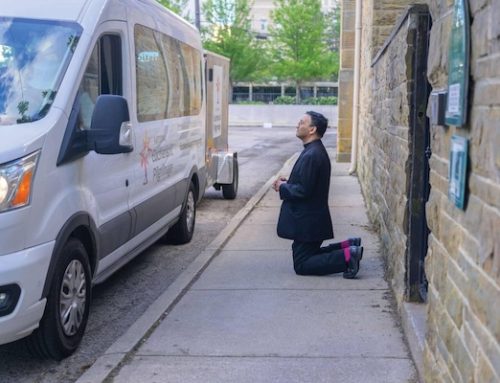
Well, yeah. But let me be clear. I’ve been giving out Holy Communion for more than 20 years, as a layman and as a deacon. I’ve done it all over the United States, in large parishes and small ones, in chapels and in cathedrals, in cities and small towns. I’ve rarely encountered more than a handful of people at any given Mass who do not receive standing and who prefer to kneel.
I’ve never found any of these people to be distracting or disruptive. Nor have I found them to be doing it to “call attention to oneself.” The gesture is always done out of reverence and, most often, humility.
From my experience: the kneeling-and-on-the-tongue Catholics aren’t the problem.
It’s everybody else.
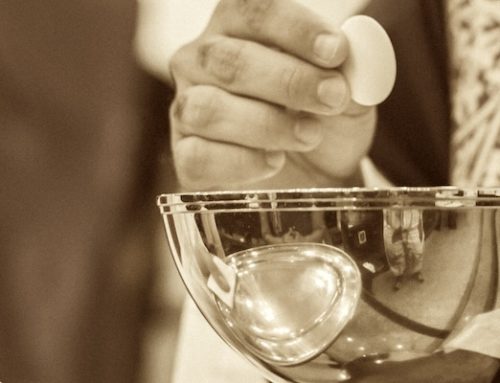
It’s the ones whom a priest friend of mine calls “The Body Snatchers” — folks who reach out, grab the host, and walk away without saying a word.
It’s The Lazy Cuppers — people who form their hands in a casual way and, far too often, allow the Body of Christ to slip to the ground.
It’s The Creative Responders — the ones who don’t know enough (or care enough) to say “Amen” after hearing “The Body of Christ.” They reply, “My Lord and my God!” or “Jesus, I trust in you” or “Thank you,” as if you’ve just passed the bread basket at Denny’s.
One of the most memorable experiences I had distributing Holy Communion was at a small parish in Iowa, and it was one of the few places where every single person who came up to me for Communion received in the hand. Every person did it reverently and carefully. And the ritual was unexpectedly moving. After a while I noticed that every palm I touched, every hand I grazed, was calloused. These were factory workers and farmers — the fields around the church were full of growing corn — and placing the Body of Christ in every palm was a quiet but eloquent reminder that none of us is perfect. We live with callouses and scars. The hands that reached out for Jesus were blessedly, beautifully rough and worn. I thought of Joseph the Carpenter, Simon Peter the Fisherman, and Jesus Christ the Preacher and Healer, the Son of God who was nailed to wood.
A few years ago, Pope Francis spoke of what it means to receive Communion:
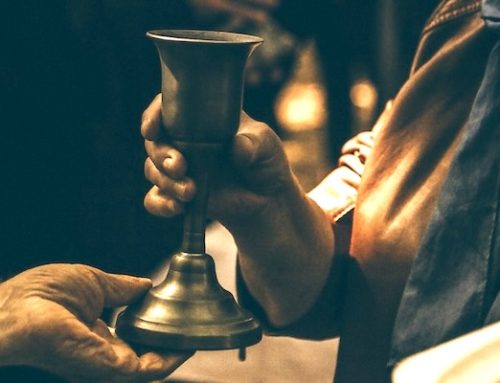
Although we are the ones who stand in procession to receive Communion; we approach the altar in a procession to receive communion, in reality it is Christ who comes towards us to assimilate us in him. There is an encounter with Jesus! To nourish oneself of the Eucharist means to allow oneself to be changed by what we receive. Saint Augustine helps us understand this when he talks about the light he received when he heard Christ say to him: “I am the food of strong men; grow, and you shall feed upon me; nor shall you convert me, like the food of your flesh, into you, but you shall be converted into me” (Confessions VII, 10, 16: pl 32, 742). Each time we receive Communion, we resemble Jesus more; we transform ourselves more fully into Jesus. As the Bread and the Wine are converted into the Body and Blood of the Lord, so too those who receive it with faith are transformed into a living Eucharist. You reply “Amen” to the priest who distributes the Eucharist saying “the Body of Christ”; that is, you recognize the grace and the commitment involved in becoming the Body of Christ. Because when you receive the Eucharist, you become the Body of Christ. This is beautiful; it is very beautiful. As it unites us to Christ, tearing us away from our selfishness, Communion opens us and unites us to all those who are a single thing in him. This is the wonder of Communion: we become what we receive!
According to the ecclesial practice, the faithful approach the Eucharist normally in a processional form, as we have said, and, standing with devotion or kneeling, as established by the Episcopal Conference, receive the sacrament in the mouth or, where permitted, in the hand, as preferred (cf. General Order of the Roman Missal, 160-161).
What matters isn’t posture, but attitude — not our position, but our perspective.
If we truly care about these matters, we need to do a much better job catechizing the faithful to receive with reverence, no matter how they do it, and to cherish more deeply the norms of the Church. Priests and deacons: take time, perhaps on the Feast of Corpus Christi, to reflect on how we receive and why, and how it can be done better.
There are various ways to receive Christ, but ultimately it has to be done with gratitude, with wonder, with respect, with love and with the overwhelming realization that, yes, we become what we receive.