As we mark the saint’s feast today, here’s a look back at a powerful moment of recent history, via John Allen in Crux:
It was 11:03 a.m. on July 19, 1943, when some 500 American planes under the command of General James “Jimmy” Doolittle began dropping more than 4,000 bombs on the Eternal City, altogether amounting to more than 1,000 tons of explosives. The worst damage came to the Roman neighborhood of San Lorenzo, home of the famed Basilica of San Lorenzo fuori le mura (“St. Lawrence Outside the Walls”), which is adjacent to the massive Campo Verano cemetery.
American forces had landed on Sicily just a few days before the bombing raid and would soon begin making their way north, so the idea of the raid was to weaken Mussolini’s grip on power and encourage Italy’s partisans to rise up and support the Allied effort.
In the end, the raid of July 19 would leave 3,000 people dead, 11,000 injured, 10,000 houses destroyed and at least 40,000 Romans homeless.
Most dramatic for Roman consciousness was the near-destruction of the basilica, which, in various forms, had occupied the spot near the traditional tomb of St. Lawrence since the fourth century. Prior to that point, Romans had believed the city would be spared the worst of the war’s carnage because of its artistic and spiritual patrimony, but the raid shattered that illusion.
Romans were left dazed and terrified, feeling suddenly vulnerable. Into that mix stepped Pope Pius XII, Eugenio Pacelli, the last native Roman to be elected pope, and thus someone who could instinctively read the mood of the city.
Pius XII immediately decided to set off to visit the site of the destruction at San Lorenzo, arriving at 2:00 p.m., according to a local pastor who saw the pontiff’s car pull up. The timing is important, because according to after-action reports by American pilots, the last bombs weren’t dropped until 2:30 p.m., which means the pope showed up while the raid was still underway.
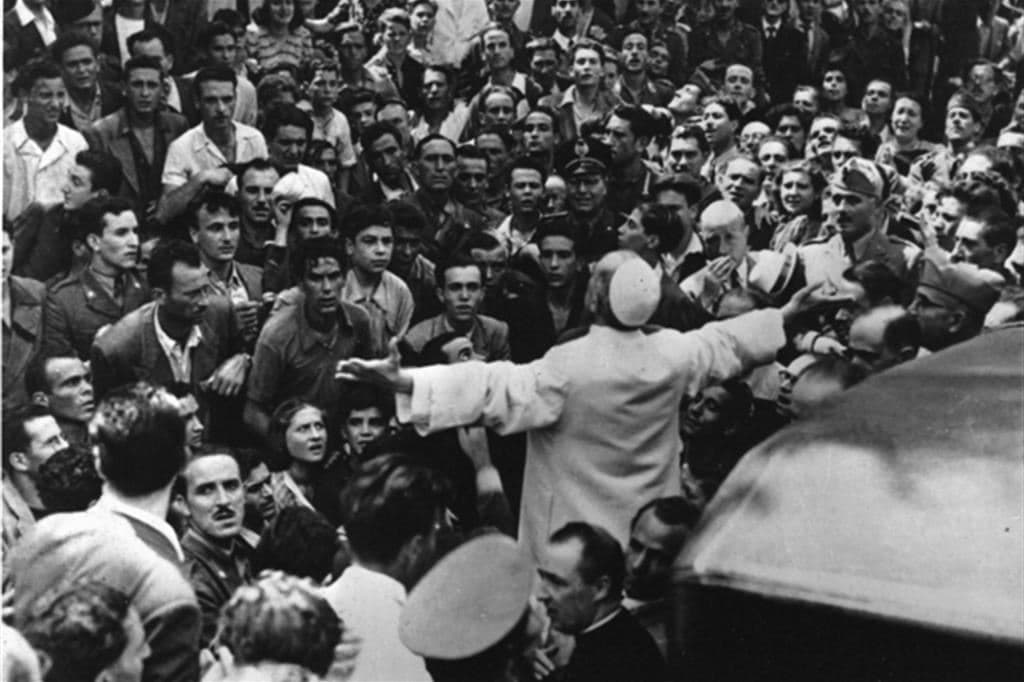
… The pope’s visit was not announced, but word quickly got out and a massive crowd of survivors and residents of the neighborhood formed around him. Witnesses reported seeing the pope’s white cassock stained with blood as he prayed with the crowd and blessed them, consoling them for their losses.
A photograph of Pius XII standing in front of the crowd with his arms stretched out, as if imploring heaven to spare them and the city further anguish, quickly became the iconic image of the visit, and is memorialized in a nearby statue in the Campo Verano. (Today historians believe that particular photo was actually from a later moment, but it’s still passed into the popular mind as the day’s defining moment.)
More than any other single factor, it was Pius XII’s courage and pastoral presence on July 19, 1943, which earned him the epithet of Defensor Civitatis, “Defender of the City.” So moved was Pius by the experience that he actually hoped to be buried at the Basilica of San Lorenzo, which proved impossible in the end because of the damage the basilica had endured.
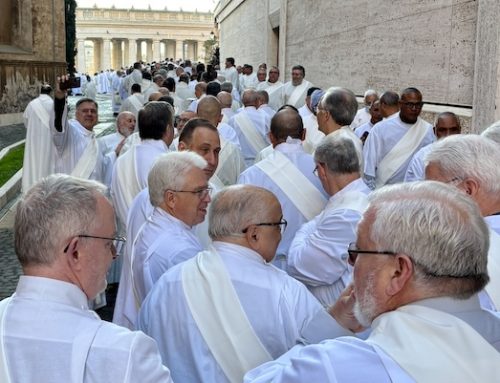
In February of this year, I joined deacons and their wives on a pilgrimage to Italy for the Jubilee of Deacons, and we spent time at St. Paul Outside the Walls. It was a humbling, inspiring experience.