Here’s a different way of looking at the ministery, from someone who has written about the saint, Elizabeth Schrader Polczeer:
Throughout the history of the church, people have always wondered whether Lazarus’ sister Mary is the same woman as Mary Magdalene. Several years ago, I published a study of previously overlooked manuscript variants in the story of Lazarus, and came to the conclusion that Martha, a character from Luke, might have been editorially added to this story to diminish Mary’s importance (click here to see the argument in full).
Incredibly, by combining real readings from just three of the world’s most important Gospel manuscripts, John 11:1-5 can be fully and sensibly reconstructed without Martha:
1 There was a certain sick man, Lazarus of Bethany, the village of Mary his sister.
2 Now this was the Mary who anointed the Lord with ointment and wiped his feet with her hair, whose brother Lazarus was sick.
3 Therefore Mary sent to him, saying, “Lord, behold, the one you love is sick.”
4 But when Jesus heard he said to her, “The sickness is not unto death, but for the glory of God, so that the Son may be glorified through it.”
5 Now Jesus loved Lazarus and his sister.Martha’s presence is also inconsistent in ancient artwork, as well as in the writings of church fathers; around 210 CE, Tertullian even stated that Mary was the Christological confessor of John 11:27! The obvious textual parallels between the Lazarus story and Mary Magdalene’s encounter with Jesus imply that Mary of Bethany would more likely be identifiable as Mary Magdalene if Martha were not present in John.
In a 2021 study I co-authored with professor Joan Taylor, we also demonstrated that the word “Magdalene” does not necessarily reference Mary’s hometown; it could just as well be an honorific title referencing Mary as “the magnified one” or “the Tower-ess.”
So, why would somebody add Martha to John’s Gospel? This theorized editorial change would have ensured that in this Gospel, the woman confessing Jesus as the Christ (John 11:27) cannot be understood to be the first person to whom the risen Jesus appears (John 20:11-18). If Martha were not present, Mary (Magdalene?) would perform five crucial ministries throughout the second half of John:
- Confessing Jesus as the Christ (John 11:27);
- Serving (diakonei) the supper (John 12:2);
- Anointing Jesus for burial (John 11:2, 12:3);
- Witnessing his death and resurrection (John 19:25, 20:1, 11-17);
- Proclaiming the Resurrection (John 20:18).
Historian Diana Butler Bass argues that these five roles can be understood as a model for “Marian ministry,” and through them we may be able to recover something of the evangelist’s original vision for women. She and I have already submitted this proposal for the synod’s consideration.
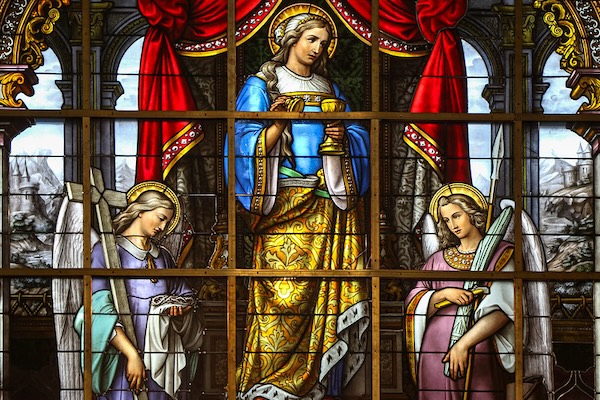
Image: Mary Magdalene / St. Nicholas Church, Ghent, Belgium / by Lawrence OP / Creative Commons license