
The New York Times offers one answer, from an event arranged by Father James Martin Tuesday morning:
As a Jesuit priest for more than two decades, the Rev. James Martin has bestowed thousands of blessings — on rosary beads, on babies, on homes, boats, and meals, on statues of saints, on the sick, on brides and on grooms.
Never before, though, was he permitted to bless a same-sex couple — not until Monday, when the pope said he would allow such blessings, an announcement that reverberated through the church.
On Tuesday morning, Damian Steidl Jack, 44, and his husband, Jason Steidl Jack, 38, stood before Father Martin in a living room on Manhattan’s West Side. The couple, running a bit late because of subway delays, dressed casually. Damian, a floral designer, complimented Father Martin on the pine smell of the Christmas tree.
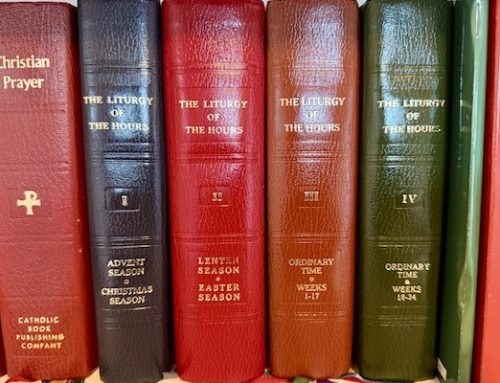
In keeping with the Vatican’s admonition that such a blessing should not be performed with “any clothing, gestures, or words that are proper to a wedding,” Father Martin wore no robes, and read from no text. There is no blessing for same-sex couples in the thick book of blessings published by the U.S. Conference of Bishops. Instead he selected a favorite of his own from the Old Testament.
“May the Lord bless and keep you,” Father Martin began, touching the two men’s shoulders. They bowed their heads slightly, and held hands.
“May the Lord make his face shine upon you, and be gracious to you. May the Lord turn his countenance to you and give you joy and peace.
“And may almighty God bless you,” he said, making the sign of the cross, “the Father, the Son, and the Holy Spirit. Amen.”
And then, with emotion evident on their faces, the three men hugged.
Simple blessings without a liturgy are usually brief and informal. The Book of Blessings offers lengthy options for everything from the blessing of boats and “Technical Installations or Equipment” to the blessing of rosaries. In some instances, it offers shorter forms that can be said quickly after Mass or on the go. (The “short formulary” for the blessing of a rosary, which every priest and deacon knows, reads simply: “May this rosary and the one who uses it be blessed, in the name of the Father, and of the Son + and of the Holy Spirit. Amen.”)
But what about something as new and unfamiliar as a blessing for people in “irregular situations”?
As noted above, Father James Martin turned to the familiar Priestly Blessing from the Old Testament’s Book of Numbers (Numbers 6:24-26). It’s widely known and often quoted; I used this same blessing as part of the grace at a reception following my Mass of Thanksgiving after my ordination in 2007.
Yesterday, when someone online wondered what sort of words could be said for blessing people in these “irregular” circumstances, my friend Deacon Bill Ditewig offered this:
“God bless you on your journey to a deeper relationship with Christ. + In the name of the Father, and of the Son, and of the Holy Spirit.”
I also remembered these words, one of the options offered for the final blessing in the Rite of Baptism — which has been bestowed on people in all sorts of situations, “irregular” and “regular,” countless times:
“May God, the lover of all, look mercifully on [you], that he may guard you from evil and bestow on you abundant peace.”
For my part, I suggested these words or something similar:
“May the Lord bless you. May he give you the grace to seek to do His will every day with humble obedience, quiet faithfulness and joyful hope. And may our Blessed Mother and St. Joseph watch over you and guide you along your way. + In the name of the Father, and of the Son, and of the Holy Spirit. Amen.”
Those are for starters. I’m sure other variations will emerge.
Meantime, I found this primer on blessings at Aleteia to be a useful reminder of what blessing are, and what they aren’t, with citations from the catechism:
Blessing expresses the basic movement of Christian prayer: it is an encounter between God and man. In blessing, God’s gift and man’s acceptance of it are united in dialogue with each other. The prayer of blessing is man’s response to God’s gifts: because God blesses, the human heart can in return bless the One who is the source of every blessing. (2626)
Another aspect of “blessing” is to pray that the graces of God may be given to another individual.
[Blessing] is used to express a wish or desire that all good fortune, especially of a spiritual or supernatural kind, may go with the person or thing, as when David says: “Blessed art thou, and it shall be well with thee” (Ps. cxxvii, 2).