“Although we find many positive elements that help to heed the call of the Gospel, when we consider the overall set of messages tied to this spiritual experience, some people believe that certain messages contain contradictions or are connected with the desires or interests of the alleged visionaries or others.”
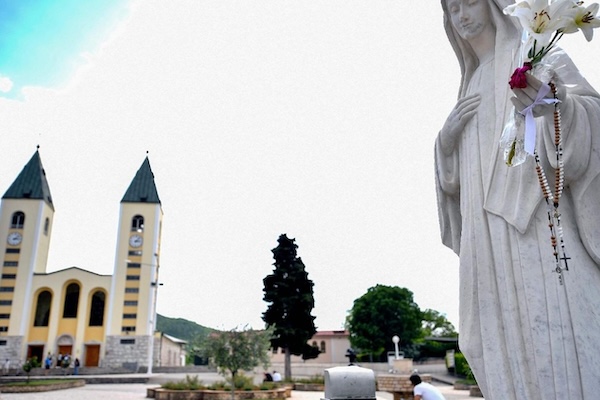
The Vatican on Thursday gave the green light for Catholics to continue flocking to a southern Bosnian village where children reported seeing visions of the Virgin Mary, offering its approval for devotion to one of the most contested aspects of Roman Catholic practice in recent years.
In a detailed analysis after nearly 15 years of study, the Vatican’s doctrine office didn’t declare that the reported apparitions in Medjugorje were authentic or of supernatural origin. And it flagged concerns about contradictions in some of the “messages” the alleged visionaries say they have received over the years.
The Vatican’s Dicastery for the Doctrine of the Faith (DDF) presented the document, titled, “The Queen of Peace,” in a news conference.
In the foreword for the nearly 20-page document, approved by Pope Francis Aug. 28, the DDF said, “The time has come to conclude a long and complex history that has surrounded the spiritual phenomena of Medjugorje.”
A synthesis stated that the approval for devotion to Medjugorje was given due to “the abundant spiritual fruits received at the sanctuary of the Queen of Peace, without making a declaration on the alleged supernatural character of Marian apparitions.”
“Many positive fruits have been noted in the midst of a spiritual experience, while negative and dangerous effects have not spread among the People of God,” the synthesis said.
However, the DDF insisted that the approval of devotion does not constitute “a judgment about the moral life of the alleged visionaries” and that any spiritual gifts received by a person “do not necessarily require those involved to have moral perfection.”
The DDF also urged a certain caution, saying, “Although we find many positive elements that help to heed the call of the Gospel, when we consider the overall set of messages tied to this spiritual experience, some people believe that certain messages contain contradictions or are connected with the desires or interests of the alleged visionaries or others.”
“It cannot be ruled out that this may have happened in the case of a few messages,” the document said, saying it is possible that “some error of a natural order” might be present, “not due to bad intentions, but to the subjective perception of the phenomenon.”
The Vatican’s ultimate ruling, the document said, was based largely on “the existence of clearly verified fruits, together with an analysis of the alleged Marian messages.”
Positive fruits associated with “the Medjugorje phenomenon,” the document said, can most prominently be seen in “a healthy practice of a life of faith, in accordance with the tradition of the Church.”
And there’s this, from the Vatican Media report:
The Note says some messages are problematic when they attribute expressions like “my plan” and “my project” to Mary, expressions that “might create some confusion.”
“In reality, everything Mary accomplishes is always at the service of the Lord’s plan and His divine plan of salvation,” it says, adding that Christians must never “attribute to Mary a place that belongs uniquely and exclusively to the Son of God made man.”
Instead, the Dicastery for the Doctrine of the Faith emphasizes a message that can be considered a synthesis of the Gospel proposal through Medjugorje: “I desire to draw you ever closer to Jesus and his wounded heart” (November 25, 1991).
“While this does not imply a declaration of the supernatural character of the phenomenon in question (cf. Norms, art. 22, §2), and recalling that the faithful are not obliged to believe in it, the nihil obstat [issued by the Bishop of Mostar-Duvno in agreement with the Holy See, ed.] indicates that the faithful can receive a positive encouragement for their Christian life through this spiritual proposal and it authorizes public acts of devotion.”
The Note clarifies that “the positive assessment that most of the messages of Medjugorje are edifying does not imply a declaration that they have a direct supernatural origin.”
Even though there are – as is known – various opinions “about the authenticity of some facts or certain aspects of this spiritual experience, the ecclesiastical authorities of the places where it is present are invited to ‘appreciate the pastoral value of this spiritual proposal, and even to promote its spread’.”
However, adds the Note, each diocesan bishop has the freedom and authority to make prudent decisions regarding “groups or persons who, by misusing this spiritual phenomenon, act in a mistaken way” in his own diocese.
Finally, the Dicastery invites pilgrims who visit Medjugorje “to be strongly advised that pilgrimages are not made to meet with alleged visionaries but to have an encounter with Mary, the Queen of Peace.”
Read the full note, “Queen of Peace.”
CNA, meanwhile, offers this helpful timeline, outlining the history of Medjugorje and what the Church has said over the decades.