
From the archdiocese:
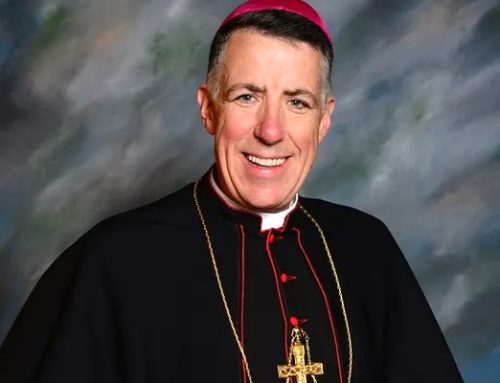
Pope Francis has appointed Bishop Edward J. Weisenburger, currently Bishop of the Diocese of Tucson, as the sixth Archbishop of Detroit. The archbishop-elect succeeds Archbishop Allen H. Vigneron, who has served the archdiocese since 2009.
The new archbishop will be installed during a 2 p.m. Mass at the Cathedral of the Most Blessed Sacrament on March 18. In addition, at 5:30 p.m. on March 17, he will lead Vespers (evening prayer) at Sacred Heart Major Seminary.
“The Archdiocese of Detroit is a Church steeped in rich history, vibrant ministries, and known for a committed clergy with a great passion for evangelization. I am humbled to be called to serve such a noble Church. Despite the challenge of leaving my happy home in the Diocese of Tucson, I promise the good people of the Archdiocese of Detroit my all,” Archbishop-elect Weisenburger said. “I am exceptionally grateful to Archbishop Vigneron for the warmth, kindness, and encouragement he expressed to me immediately upon learning of my assignment. His generous assurance of a warm welcome and his desire to be of fraternal help to me is a true blessing. It is my hope that his retirement will be marked by length of years, robust health, and many rich blessings.”
More about the new archbishop, from his official biography:
Edward Joseph Weisenburger was born in Alton, Illinois, on December 23, 1960, to Edward John Weisenburger and Asella (Walters) Weisenburger, the third of their four surviving children.
His father was a military officer and his mother a homemaker. Weisenburger grew up primarily in Lawton, Oklahoma. He attended Conception Seminary College in Missouri, graduating with honors in 1983.
He then attended the American College Seminary at the Catholic University of Louvain in Belgium, earning the Pontifical S.T.B. in Theology, an M.A. in Religious Studies, and a Masters in Moral and Religious Sciences. On December 19, 1987, he was ordained to the priesthood at the Cathedral of Our Lady of Perpetual Help in Oklahoma City.
Weisenburger attended the University of St. Paul in Ottawa, Canada, from 1990 to 1992, earning the pontifical J.C.L. degree in canon law. Upon his return home, he was appointed Vice-Chancellor and Adjutant Judicial Vicar.
In addition to chancery and tribunal duties, he also did weekend parish and prison ministries from 1992-95 and served as an on-site chaplain for rescue workers in the weeks following the April 19, 1995 bombing of the Murrah Federal Building in Oklahoma City.
In the fall of 1995, he began 17 years of service on the Council of Priests and the Archdiocesan College of Consulters. He likewise served as a member of the Seminarian Board for 15 years. In June 1996, he was appointed Vicar General of the Oklahoma Archdiocese.
He was an officer with the Archdiocesan Tribunal for almost 20 years and served as Promoter of Justice for the cause of canonization of Blessed Stanley Francis Rother. On October 2, 2009, he was appointed a Prelate of Honor to His Holiness, Pope Benedict XVI, with the title Reverend Monsignor.
Weisenburger served as pastor of two Oklahoma parishes: Holy Trinity in Okarche (1995-2002) and the Cathedral of Our Lady of Perpetual Help in Oklahoma City (2002-12).
On February 6, 2012, Weisenburger was appointed Bishop of Salina, Kansas, by His Holiness, Pope Benedict XVI. He was ordained a bishop at the Cathedral of the Sacred Heart in Salina, on May 1, 2012, with the Most Reverend Joseph Naumann, Archbishop of Kansas City presiding.
On October 3, 2017, Weisenburger was appointed Bishop of Tucson by His Holiness, Pope Francis. He was installed as Bishop of Tucson on November 29, 2017.
Bishop Weisenburger serves the United States Conference of Catholic Bishops (USCCB) on the Committee for Migration as well as the Subcommittee on the Catholic Communication Campaign.
He serves as Episcopal Moderator for the National Association of Church Personnel Administrators (NACPA), is a member of Chicago’s Mundelein Seminary Board, and is a past Board Chairman of Catholic Rural Life.