I’ve posted about this on Facebook a few times over the last couple of weeks — the rapid multiplication of fake Pope Leo memes that a surprising number of people believe are real.
Over at Substack, Steven Greydanus offers some advice on ferreting out fake quotes and memes, and notes:
Why do fake quote attributions matter?
“It doesn’t matter who said it, as long as it’s inspiring” is an attitude some people take, usually after passing on quotes with fake attributions. Really, though, almost everyone believes attributions matter. That’s why quotations tend to become linked to people more famous than whoever really said it: to burnish their perceived weight or authority.
If the quotation itself is any good, the fake attribution denies credit where credit is due. Kierkegaard doesn’t need any more glory, but if a Dutch philosopher and clergyman named Gerard van der Leeuw wrote something that got plagiarized in Dune, hey, let’s give the man his due.
Sometimes fake attributions lend extra authority or respectability to suspect ideas.
But the problem isn’t just quotes. Astonishingly lifelike videos are popping up. Mike Lewis breaks open this phenomenon and tells us why attention must be paid:
In the days following Pope Leo XIV’s election, the internet has been inundated with AI-generated deepfake videos, images, and messages purporting to depict the new pontiff. These media fabrications, some of which have been circulated on platforms like YouTube and TikTok, present the pope delivering messages he never said, sometimes even in his own voice.
For example, a YouTube video entitled, “POPES WAKEUP URGENT CALL TO ALL TRUE CHRISTIANS || POPE LEO XIV SPEECH,” posted on a channel called “Pope Leo XIV Sermons,” delivers a fiery 42-minute exhortation about the end times in an AI-generated voice based on that of Pope Leo.
A snippet:
The sky is heavy with prophecy. The clock of heaven is ticking its final seconds. And I declare to you today: 2025 is not just another year. It is a spiritual alarm sounding in the heavens for all who still have ears to hear. Look around you. Do you not see it? The world is unraveling at the seams.
The entire thing pretty much goes on like that, speaking of signs, warnings, and the end of the world, but without actually saying much with specificity or substance. My guess is that the script is AI-generated as well. I would say the whole thing is silly, except that this channel has over 13,000 subscribers and the video has over 230,000 views.
Most concerning is that some Catholics have been misled by these videos. A friend mentioned that her brother-in-law was sending AI-generated videos to their family’s group chat. When it was pointed out to him that the video pages even had clear labels indicating the content was fake, he refused to believe it, insisting, “Why would someone fake such a beautiful sermon?”
Another friend shared with me that his mother told him that she thought the aforementioned AI-generated video about the end times was genuine. Even after he explained it was fake, she responded, “It was still a good message.”
I sent a link to the video to a priest friend of mine. He responded that they’d just had a parish talk on the papacy, and at one point a participant stood up and shared a fake Pope Leo prayer they found on social media. My priest friend remarked, “This is going to be a massive problem.”
All three of these exchanges happened within a five-hour timespan.
The technology behind deepfakes has advanced rapidly, making them increasingly difficult to distinguish from genuine content. And as the aforementioned examples demonstrate, even a vague and longwinded AI-generated endtimes warning can fool many people. As AI continues to improve, the line between real and fake content becomes increasingly blurred. We all must develop skills to avoid being deceived.
Read on over at Where Peter Is.
The deepfake phenomenon has been around for a while; it was not uncommon to find doctored images of Pope Francis popping up. Catholic World Report took note:
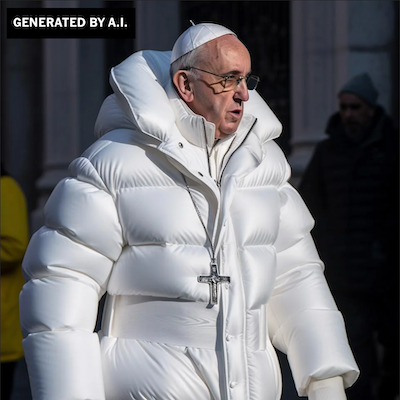
Some may recall the deepfake images of Pope Francis sporting an oversized designer puffer jacket that circulated on social media in 2023. In late 2024, artificially generated images purporting to depict the Pope in the embrace of an aging pop star drew further attention. These instances of deception, however, may seem innocuous compared to some recent AI-generated appropriations of the likenesses of members of the Roman Catholic hierarchy.
The year 2025 brings a new round of ecclesiastically themed deepfakes with a much higher order of gravity: they cannot be justified as simply jocose. Instead, they have been produced for a distinctly commercial purpose: to promote the sale of a product that—at best—is theologically dubious.
A set of interrelated deepfake video advertisements currently queuing on YouTube features the likenesses of Pope Francis and Cardinal Mark Ouellet, the former Prefect for the Dicastery of Bishops. The deepfake video impersonations of the bishops are used to promote the sale of a mysterious prayer that is claimed to bring extreme wealth and worldly success to those willing to say its words. The 90-word prayer, with a regular price of $179, can be accessed by viewers for the newly discounted price of $59.
The deepfake portion featuring Pope Francis’s endorsement of the prayer is an AI alteration of a real video. In May 2024, Pope Francis was interviewed by CBS journalist Nora O’Donnell for the news program 60 Minutes. The video of that interview—conducted in Spanish with the help of a translator—has been modified for the convincing deepfake. The altered version features Francis speaking perfectly fluent English, with facial gestures and moving lips that match each uttered word. The embedded 60 Minutes logo in the upper left corner of the original has been covered over in the deepfake with a small emblem featuring the recognizable Christian symbols of a cross and a dove above an open book. In contrast to the Pope’s wide-ranging responses to the journalist’s various interview questions, the content of the deepfake pontiff’s message is singularly focused: it is a crass sales pitch.
Be aware. And be worried.