
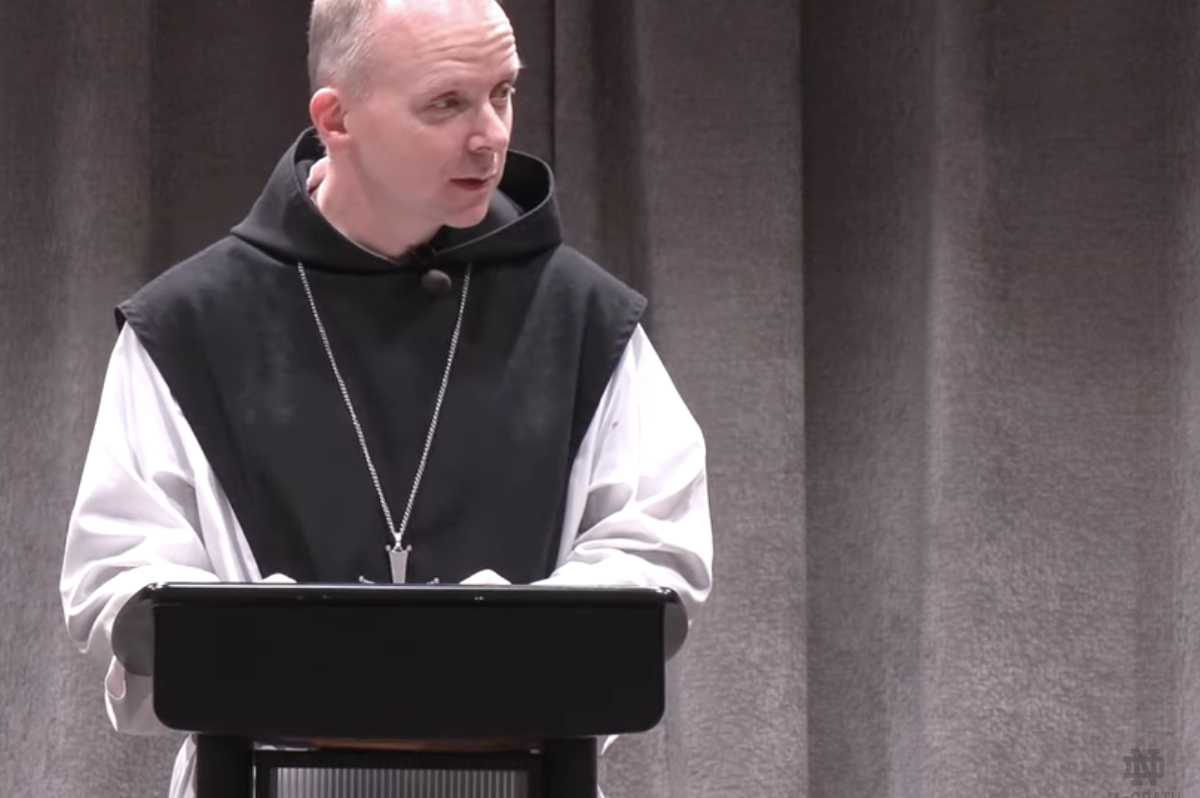
Sunday, Bishop Erik Varden, the Trappist who serves as Bishop of Trondheim in Norway, began to preach the Lenten retreat for Pope Leo and the Roman curia. It turns out that Bishop Varden has a blog — and he posted part of his first talk on the topic of “Entering Lent”:
It is timely to articulate the radicality of Christian ‘peace’ while we remind ourselves and others of the truth in St John Climacus’s words: ‘There is no greater obstacle to the presence of the Spirit in us than anger.’
The Church instils our Lenten program with peace. She detracts nothing from her call to do battle against vices and harmful passions — her language is ‘Yes, yes’, ‘No, no’, not ‘sometimes this’, ‘sometimes that’.
She gives us instead, as we start each Lent’s battle, a peaceful melody as a seasonal soundtrack: a tract of great beauty that, for over a thousand years, the Church has sung on the First Sunday of Lent, to introduce the account of Christ’s temptation in the wilderness.
The tract sets the text of Psalm 90, the Qui habitat. This work of melodic exegesis deserves attention. It is not just a relic of ancient aesthetics. It carries a vital message.
St Bernard of Clairvaux was attentive to this message. In the Lent of 1139 he preached a cycle of 17 sermons on the Qui habitat, reflecting on what it means to live by grace as we fight evil, foster good, uphold truth, and follow the exodus path from unfreedom towards the land of promise, veering neither to the right nor to the left, remaining peaceful, conscious that underneath what may at times seem to us a tight-rope walk ‘are the everlasting arms’.
He summons us to loving and clear-headed discipleship.
Monday brought his second chapter, on St. Bernard of Clairvaux — with a mention of another celebrated Trappist, Thomas Merton.
Of St. Bernard, he said:
He was a genuinely humble man, fully given to God, capable of tender kindness, a firm friend—indeed, able to befriend former enemies—and a compelling witness to God’s love. He was, and remains, fascinating.
Dom James Fox, entrepreneurial abbot of Gethsemani from 1948 to 67 once wrote in exasperation about his confrère Thomas Merton: ‘His mind is so electrical!’ Merton wound Fox up with his ideas, intuitions, and insistence. Yet Fox knew him to be genuine. He respected him, enjoyed his company (when they were not in the middle of some epic quarrel), and went to Merton for confession for most of his abbacy.
It would be daft to compare Thomas Merton to Bernard of Clairvaux, yet there is temperamental similarity. While Bernard never knew about electricity, his was a quicksilver nature containing and having to equilibrate massive tensions.
Bernard’s teaching on conversion is born of a Biblical culture second to none and of well-pondered notions of theology. It is also, and increasingly so with the passage of time, born of personal struggle as he learns not to take it for granted that his course is always the right course, taught by experience, hurts, and provocations to consider his self-righteousness and marvel before God’s merciful justice.
Bernard is a good, wise companion for anyone setting out on a Lenten exodus from selfishness and pride, wishing to pursue authenticity with eyes set on the all-illumining love of God.