
22 million.
At last count, that is the number of people who watched Erika Kirk’s speech at her husband’s memorial service last Sunday.
22 million people.
Those who saw it won’t forget it.
Days after her husband’s brutal assassination, the widow of Charlie Kirk stood on a stage in Arizona before 100-thousand people, and millions more watching on television and listening on the radio and did what some would consider unthinkable. She forgave the man who did it.
“On the cross,” she said, “our Savior said, ‘Father, forgive them, for they know not what they do. That man, that young man, I forgive him. I forgive him because it’s what Christ did. And it’s what Charlie would do.”
On television the next morning, historian Jon Meacham compared it to the moment when Pope John Paul II publicly forgave the man who tried to assassinate him and asked the world to pray for him.
I was reminded of the compassion of the Amish of Nickel Mines, Pennsylvania. Back in 2006, days after a gunman opened fire on their children in a schoolhouse, the grieving parents went to the home of his widow to offer their consolation, their prayers and their forgiveness.
These moments of public grace and mercy are extraordinary. We can’t forget them. We need to be reminded how much better we can be — how we can summon what Lincoln called the “better angels of our nature.”
But there is more. Attention must also be paid to something else Erika Kirk said, immediately after she forgave her husband’s killer. It has a direct bearing on the Gospel we just heard.
“The answer to hate is not hate,” she said. “The answer—we know from the Gospel—is love. Always love.”
Love.
That is something absent from this Gospel. The parable of the rich man and Lazarus shows us something else.
The great activist and writer Eli Wiesel understood. Wiesel survived the Holocaust and spent his life challenging the world to pay attention, to never forget. He once said, “The opposite of love isn’t hate. It’s indifference.”
Indifference.
The dictionary defines it this way: the quality of not caring about something or someone.
In other words: Having a heart of stone. Being incapable of compassion.
How often do we see that in our world today? Elie Wiesel saw it. He lived it. He knew.
Indifference means looking the other way. It means being able to comfortably ignore cruelty or bigotry or sin.
It means noticing suffering on the street or begging at your door, but we step over it and figure, “It’s not affecting me. It’s somebody else’s problem.”
In the parable of the rich man and Lazarus, we are reminded that sometimes the most serious sin is not a sin of commission, but a sin of omission.
At the start of every Mass, we pray for forgiveness “for what I have done and what I have failed to do.”
This Gospel points to each of us and asks, “What have you failed to do? What could you have done, but didn’t? When you had a chance to make a difference, did you?”
Jesus says it in a particular way about the poor. But I think it goes much further than that.
We need to remember that there are many kinds of poverty. We live in a world where people not only lack food and shelter and security. They often lack dignity. Friendship. People hunger for justice. They hunger for hope.
We can’t just shrug it off. We do it at our own peril. Like the rich man, we could ultimately pay the price.
Considering this parable, there are two details about it that strike at the heart.
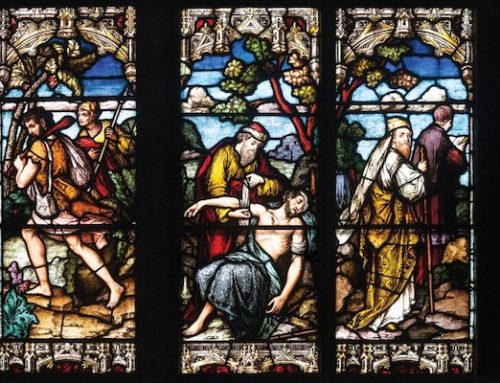
First, in all the parables we’ve been hearing over the last several weeks from Luke — the Good Samaritan, the Rich Man with the Barn, the Unjust Steward — this is the only one where someone is actually given a name: Lazarus. Why? Well, that name means “Helped by God” or in some translations, “God is my help.” This sick, suffering figure that nobody takes time to notice or care about has a distinct identity. He matters. We don’t know why he is poor, what led him to this station in life, but Jesus takes the time to give him the dignity of a name.
The one who is ignored by others is helped by God. He is loved.
Secondly, as with so many of Luke’s parables, the one character in the story that most people would think is worthless or even the villain is the one who matters the most. Jesus turns our expectations upside down.
That recurring lesson: Think twice. Look closely. Everyone — even a beggar or a Samaritan — has something to teach us. Everyone can astonish us. Be open to that possibility. That beggar, that addict, that refugee, that runaway…is Lazarus. The ones the world steps over or belittles or avoids matters.
Ultimately, to be a follower of Christ, to claim the title “Christian,” means we want to do what he would do.
As Erika Kirk reminded the world, that means to love.
That means to shake off indifference.
Looked at another way, being Christian means to make a difference.
What are we doing to make a difference in the world?
As St. Teresa of Avila famously put it,
Christ has no body but yours,
No hands, no feet on earth but yours,
Yours are the eyes with which he looks
Compassion on this world,
Yours are the feet with which he walks to do good,
Yours are the hands, with which he blesses all the world.
This is the great call of our baptism. How are we fulfilling it? As we come forward to receive the Body of Christ, let us remember how we are called to BE the body of Christ.
We need to remember. Remember the challenge of this Gospel. The witness of Erika Kirk. The lesson of the humble and forgotten man who is, nonetheless, loved and helped by God.
Sometimes the most serious sin is not what we have done, but what we have failed to do.
Let us pray above all to shake off indifference — so that we may make a difference.