From The New York Times:
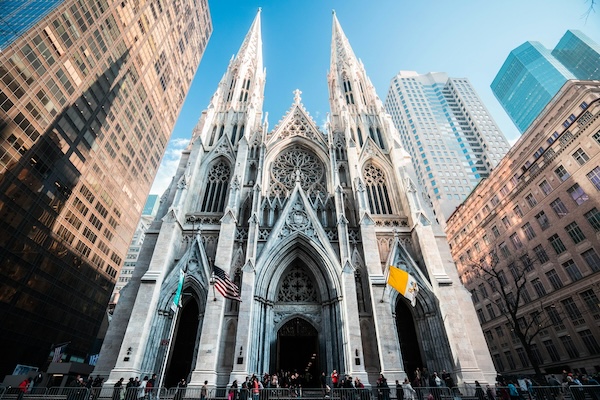
The pews of St. Patrick’s Cathedral were packed on Thursday for an event with no likely precedent in Catholic history: the funeral of Cecilia Gentili, a transgender activist and actress, former sex worker and self-professed atheist whose memorial functioned as both a celebration of her life and an exuberant piece of political theater.
Over 1,000 mourners, several hundred of whom were transgender, arrived in daring outfits — glittery miniskirts and halter tops, fishnet stockings, sumptuous fur stoles and at least one boa sewed from what appeared to be $100 bills. Mass cards and a picture near the altar showed a haloed Ms. Gentili surrounded by the Spanish words for “transvestite,” “whore,” “blessed” and “mother” above the text of Psalm 25.
That St. Patrick’s Cathedral would host the funeral for a high-profile transgender activist, who was well known for her advocacy on behalf of sex workers, transgender people and people living with H.I.V., might come as a surprise to some.
Not much more than a generation ago, at the heights of the AIDS crisis, the cathedral was a flashpoint in conflicts between gay activists and the Catholic Church, whose opposition to homosexuality and condom use enraged the community. The towering neo-Gothic building became the site of headline-grabbing protests in which activists chained themselves to the pews and lay down in the aisles.
The church has softened its tone on those issues in recent years, and New York’s current cardinal, Timothy Dolan, has said the church should be more welcoming of gay people. Joseph Zwilling, a spokesman for the Roman Catholic Archdiocese of New York, did not respond to questions about whether the church had been aware of Ms. Gentili’s background when it agreed to host her funeral.
On Wednesday, he said that “if a request comes in for a funeral from a Catholic, the cathedral does its best to accommodate.”
Ceyenne Doroshow, who organized the funeral, said friends of Ms. Gentili — who died on Feb. 6 at 52 — had wanted the service to be at St. Patrick’s because “it is an icon, just like her.” But she added that she had not mentioned that Ms. Gentili was transgender when planning with the church. “I kind of kept it under wraps,” she said.
Mr. Zwilling said he did not know whether or not Ms. Gentili had attended Mass at the cathedral, or if any other transgender people had had their funerals there. But he said that “a funeral is one of the corporal works of mercy,” a part of Catholic teaching that the church has described as “a model for how we should treat all others, as if they were Christ in disguise.”
I haven’t found any obituaries that state explicitly that Cecilia Gentili was a baptized Catholic, but at least one account noted that she had a troubled and difficult life:
She was born on Jan. 31, 1972, in Gálvez, a city in northeastern Argentina. Her father, Terdinando Gentili, was a butcher who spent more time with his mistress than at home, Ms. Gentili recalled. Her mother, Esmeralda del Pilar Ceci de Gentili, cleaned houses and suffered from depression.
The family was poor and lived in government housing, and there, when she was 6, Cecilia was molested by a neighbor, who continued to abuse her until she left home at 18. She was bullied in school and menaced outside, and sex, she said, became a survival mechanism, though at a terrible cost to her.
But Cecilia had a champion in her maternal grandmother, her abu, an Indigenous woman who lived in rural Argentina. When Cecilia came to stay with her, the grandmother let her wear her jewelry and clothes. One Sunday, when she and Cecilia attended the local Baptist church, and Cecilia was sporting a pair of her grandmother’s earrings, the pastor complained. Abu told the pastor off, and never returned.
“That was the end of church,” Ms. Gentili wrote in her letter to her grandmother, which makes up a chapter in her book, “but not of your relationship with God. You continued to read the Bible to me every night until I fell asleep with most of your jewelry on.”
But if she was Catholic? Canon law notes:
The Church’s Code of Canon Law states, in fact, that every Catholic has the right to a Catholic funeral, and the wording of the canon is strong: “Deceased members of the Christian faithful must be given ecclesiastical funerals according to the norm of law” (No. 1176).
The few exceptions to that rule are stated specifically in a subsequent canon and include such categories as “notorious apostates, heretics and schismatics” and “other manifest sinners who cannot be granted ecclesiastical funerals without public scandal of the faithful” (No. 1184).
A person who has been away from regular church attendance could not, of course, receive holy Communion without going to confession first. But it is always possible that the deceased, in the privacy of his own conscience, may not have realized the gravity of his offense or may have expressed repentance and been reconciled to the Lord.
The Church’s rule on funerals gives a person the benefit of that doubt, and the funeral Mass commends the deceased to the tender mercy of God.