With all the news about cardinals in the conclave who will be voting from far-flung places that never had cardinals until Francis created them, I was curious to learn more about the first U.S. cardinal.
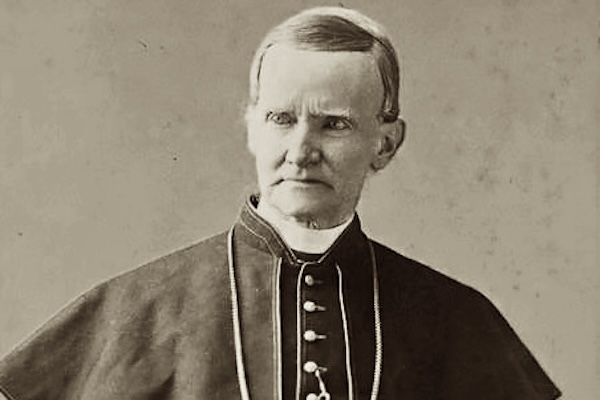
He’s John McCloskey. And he was baptized on this date, May 6, 215 years ago.
John McCloskey was born in Brooklyn, New York, to Patrick and Elizabeth (née Hassan) McCloskey, who had immigrated to the United States from County Londonderry, Ireland, shortly after their marriage in 1808. He was baptized by Rev. Benedict Joseph Fenwick, S.J., on May 6, 1810, at St. Peter’s Church in Manhattan. At that time Brooklyn did not yet have a Catholic church, so the family would row across the East River to Manhattan to attend Mass.
He grew up in Bedford, New York. While discerning a vocation, he studied at Mount St. Mary’s in Baltimore. A brief trip home changed everything — and led him to make New York history:
During the spring of 1827, McCloskey was attempting to drive a team of oxen drawing a heavy load of logs when the wagon overturned and he was buried under the logs for several hours. After being discovered and taken to the house, he was completely blind and unconscious for several days. During his convalescence, however, McCloskey decided upon a vocation to the priesthood and later returned to Mount St. Mary’s in September 1827 for his seminary training. Although he regained his eyesight, he tired easily and was generally in poor health throughout the rest of his life. In addition to his studies, he became a professor of Latin in 1829. He received the tonsure, minor orders, and subdiaconate all from Bishop Francis Kenrick.
On January 12, 1834, McCloskey was ordained a priest for the Diocese of New York by Bishop John Dubois, at St. Patrick’s Old Cathedral. He thus became the first native New Yorker to enter the diocesan priesthood.
He worked his way up through the ranks, eventually becoming Archbishop of New York:
McCloskey was created Cardinal-Priest of S. Maria sopra Minerva by Pius IX in the consistory of March 15, 1875, thus becoming the first American cardinal. The news of his elevation was well received by Catholics and non-Catholics alike, and was viewed as a sign of the growing prestige of the United States.
He received the red biretta from Archbishop Bayley in a ceremony at the rebuilt St. Patrick’s Cathedral on Mott Street on the following April 27. The Cardinal declared, “Not to my poor merits but to those of the young and already vigorous and most flourishing Catholic Church of America has this honor been given by the Supreme Pontiff. Nor am I unaware that, when the Holy Father determined to confer me this honor he had regard to the dignity of the See of New York, to the merits and devotion of the venerable clergy and numerous laity, and that he had in mind even the eminent rank of this great city and the glorious American nation.”
Following the death of Pius IX in February 1878, McCloskey left for Rome but arrived too late to participate in the papal conclave, which elected Pope Leo XIII. The new Pope bestowed the red hat upon him on March 28, 1878.
He spent a considerable amount of time as archbishop building new churches around New York City — including the city’s first parish for Black Catholics. The number of priests in the archdiocese grew from 150 to 400 during his tenure. He was also busy building schools and establishing a hospital for the mentally ill.
In the 1880’s, his health began to fail:
Throughout 1885, Cardinal McCloskey suffered from bouts of fever, intense pain, loss of sight, and a recurrence of malaria that aggravated what appeared to be signs of Parkinson’s disease. Within a few months, he was hospitalized and later died at 75. Present were his private secretary, Msgr. John Farley as well as his three beloved nieces. His funeral Mass was held at St. Patrick’s Cathedral on October 25, 1885; during the eulogy, Archbishop James Gibbons described him as “a kind father, a devoted friend, a watchful shepherd, a fearless leader and, above all, an impartial judge.” John McCloskey is interred under the main altar at St. Patrick’s on Fifth Avenue.
What a life — and what a legacy.
Though he arrived too late to vote in the conclave of 1878, perhaps he can offer some divine inspiration and guidance for this one.
Let us pray.