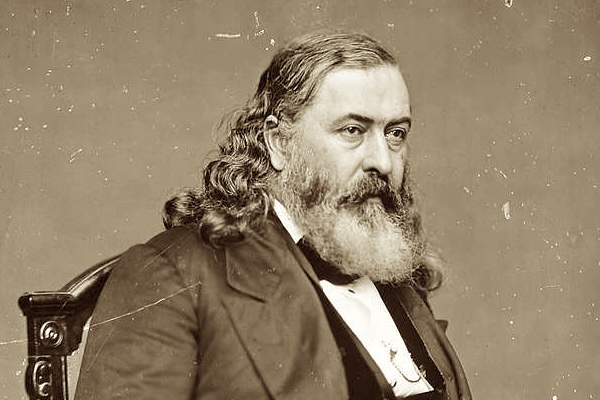
The general made some news recently:
The National Park Service is planning to restore and reinstall a statue of Albert Pike, a Confederate general and Freemason leader, that was toppled during Black Lives Matter protests in June 2020.
“The restoration aligns with federal responsibilities under historic preservation law as well as recent executive orders to beautify the nation’s capital and re-instate pre-existing statues,” the National Park Service said in a statement, pointing to President Trump’s executive order on Making the District of Columbia Safe and Beautiful and the executive order on Restoring Truth and Sanity to American History.
So who was he? The Encyclopedia of Arkansas offers this biography, which notes (among other things) that he was anti-Catholic and pro-slavery:
Albert Pike was a lawyer who played a major role in the development of the early courts of Arkansas and played an active role in the state’s politics prior to the Civil War. He also was a central figure in the development of Masonry in the state and later became a national leader of that organization. During the Civil War, he commanded the Confederacy’s Indian Territory, raising troops there and exercising field command in one battle. He also was a talented poet and writer.
Returning from Mexico, Pike reestablished his law practice. He promoted the construction of a transcontinental railroad from New Orleans to the Pacific coast, writing numerous newspaper essays urging support for this project. He moved to New Orleans in 1853 to further his railroad activities, although he also continued to practice law. He translated French legal volumes into English while preparing to pass the local bar exam for Louisiana. Ultimately, he successfully obtained a charter from the Louisiana legislature for one of his railroad projects. He returned to Little Rock in 1857.
In the years immediately following the Mexican War, Pike’s concern with the developing sectional crisis brought on by the issue of slavery became apparent. He had long been a Whig, but the Whig Party repeatedly refused to address the slavery issue. That failure and Pike’s own anti-Catholicism led him to join the Know-Nothing Party upon its creation. In 1856, he attended the new party’s national convention, but he found it equally reluctant to adopt a strong pro-slavery platform. He joined other Southern delegates in walking out of the convention. Pike expressed a belief in states’ rights and considered secession constitutional. He philosophically supported secession, demonstrating his position in 1861 when he published a pamphlet titled State or Province, Bond or Free?
Among other things, he may have been involved in organizing the Ku Klux Klan after the Civil War (though that is not certain.) He became more deeply involved in the Masons and eventually became a Grand High Priest.
Read more about his life and legacy.