On the morning of Friday, January 9, Pope Leo XIV stepped into an encounter with the Shroud of Turin unlike any experienced by his predecessors.
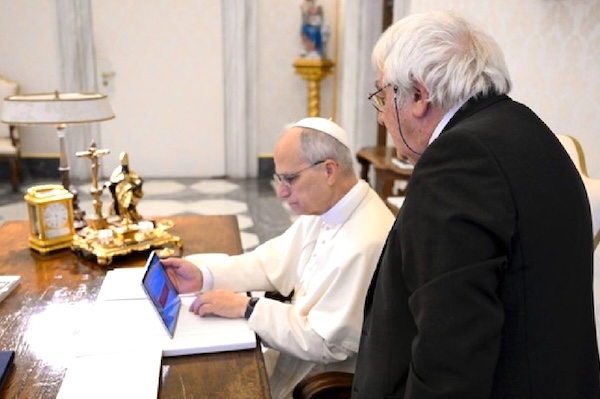
Inside the Apostolic Palace, the Pontiff became the first person to explore a new digital reading of the Shroud, an initiative known as Avvolti, presented to him by Cardinal Roberto Repole, Archbishop of Turin and pontifical custodian of the relic. The moment marked a symbolic threshold: one of Christianity’s most studied and enigmatic images entering fully into the digital age.
The initiative introduces a way of engaging with the Shroud that has never before been available to the general public. For the first time, the image can be explored online through a dedicated platform, accessible via the websites avvolti.org and sindone.org. The program works on smartphones, tablets, and computers, making the Shroud available globally without geographical or logistical barriers. What once required travel to Turin and access to rare exhibitions can now be approached from anywhere in the world.
At the heart of the project lies an interactive digital reproduction that allows users to move across the surface of the Shroud as if tracing it with their own hands. Key details—the face, the marks associated with the crown of thorns, and other elements traditionally linked to the Passion—can be enlarged and examined closely. Each magnified section is accompanied by explanatory texts and direct references to Gospel passages describing the suffering and death of Jesus. The result is not a purely visual experience but a guided reading that combines image, Scripture, and interpretation. T
he architects of the project have been careful to define its audience. While the texts and images are grounded in scientific rigor and serious scholarship, the aim is not to produce a tool for specialists alone. Instead, the digital reading is designed to be intelligible to a broad public, including those with little prior familiarity with the Shroud. The ambition is catechetical as much as educational: to allow the image to speak beyond academic circles and reach ordinary believers, seekers, and the curious.