
From CNA:
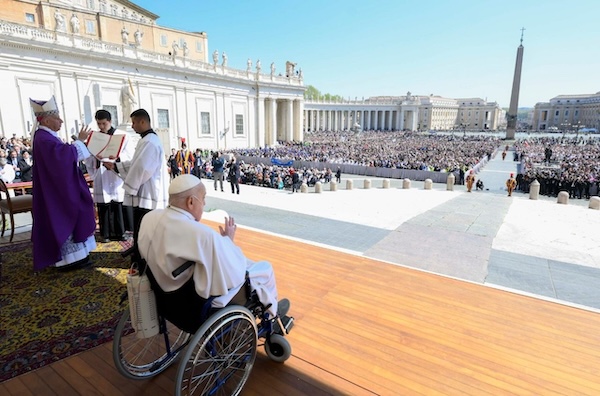
Still recovering from bilateral pneumonia that hospitalized him for nearly 40 days, Pope Francis made a surprise appearance in St. Peter’s Square on Sunday for the Jubilee of the Sick, sharing profound reflections on suffering, care, and the transformative power of illness.
Wearing nasal cannulas that provide supplemental oxygen, Pope Francis arrived in a wheelchair accompanied by a nurse.
In his homily for the Jubilee of the Sick and Health Care Workers, which was read aloud by Archbishop Rino Fisichella as the pope continues his recovery, Francis drew inspiration from the prophet Isaiah and the day’s Gospel reading to explore the spiritual dimensions of illness and healing.
The pontiff said that “the sickbed can become a ‘holy place’ of salvation and redemption, both for the sick and for those who care for them.”
“I have much in common with you at this time of my life, dear brothers and sisters who are sick: the experience of illness, of weakness, of having to depend on others in so many things, and of needing their support,” the pope told his audience.
He also offered this beautiful thought on today’s gospel, about the woman caught in adultery, in the text prepared for the Angelus:
The Gospel of this fifth Sunday of Lent presents to us the episode of the woman caught in adultery (Jn 8:1-11). While the scribes and the pharisees want to stone her, Jesus restores the lost beauty to this woman. She has fallen in the dust; Jesus passes his finger on this dust and writes a new story for her. It is the “finger of God”, who saves His children (cf. Ex 8:15) and frees them from evil (cf. Lk 11:20).
Dear friends, as during my hospitalization, even now in my convalescence I feel the “finger of God” and experience His caring touch. On the day of the Jubilee of the sick and the world of healthcare, I ask the Lord that this touch of His love may reach those who suffer and encourage those who care for them. And I pray for doctors, nurses and health workers, who are not always helped to work in adequate conditions and are sometimes even victims of aggression. Their mission is not easy and must be supported and respected. I hope that the necessary resources will be invested in treatment and research, so that health systems are inclusive and attentive to the most fragile and the poorest.