From CNA:
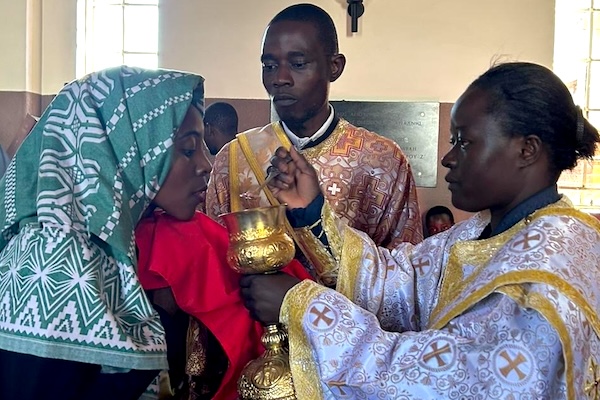
The Orthodox Patriarchate of Alexandria and All Africa ordained Zimbabwean Angelic Molen as a deaconess in the Orthodox Church. Taking place on May 2, Orthodox Holy Thursday, the ordination was conducted at St. Nektarios Mission Parish near Harare, Zimbabwe, by the archbishop of Zimbabwe, Metropolitan Serafim.
The St. Phoebe Center for the Deaconess, a U.S.-based organization that has advocated for reviving the ancient female diaconate, said in a press release that Molen’s ordination would prepare the way for the restoration of the role in other branches of the Orthodox Church. The group’s board chair, Dr. Carrie Frost, wrote: “Being the first to do anything is always a challenge, but the Patriarchate of Alexandria has courageously chosen to lead the way with Metropolitan Serafim laying his hands on Deaconess Angelic.”
According to the release, Molen said: “At first I was nervous about going into the altar, but when Metropolitan Serafim blessed me to enter the altar as part of my preparation this week, those feelings went away and I felt comfortable. I am ready.” According to the St. Phoebe Center, Molen was well received by her community and parish.
“The Alexandrian Patriarchate in Africa felt the need to revive this order to serve the daily pastoral needs of Orthodox Christians in Africa,” the release read. Metropolitan Serafim said that Molen will have both liturgical and pastoral roles. He said: “She is going to do what the deacon is doing in the liturgy and in all the sacraments in our Orthodox services.”
Serafim added that “one of the most important fields of work of the deaconess was the exercise of the works of love. They were the angels of mercy and the visiting sisters of the sick, the ‘grieving’ and poor women, imparting to them the gifts of Christian love.”
One of the important functions of deaconesses will be to distribute the Eucharist, even while their role will not be identical to the work of their counterparts of more than 1,000 years ago. However, he noted that “we must admit that women can offer the Orthodox Church a great missionary work,” as well as evangelism and teaching, and highlighted their missionary, catechetical, and teaching work. After her ordination, Molen distributed the holy Eucharist, which in the Byzantine rite is given via spoon and includes the body and the blood.
The Orthodox Patriarchate of Alexandria and All Africa has been on the way to diaconal ordination of women for several years. At a 2016 synod in Alexandria, Egypt, the Patriarchate voted to reinstate the female diaconate. In 2017, the Patriarchate ordained six sub-deaconesses in the Democratic Republic of Congo.
Worth noting: The Catholic Church recognizes the validity of Orthodox sacraments:
Everyone also knows with what great love the Christians of the East celebrate the sacred liturgy, especially the eucharistic celebration, source of the Church’s life and pledge of future glory, in which the faithful, united with their bishop, have access to God the Father through the Son, the Word made flesh, Who suffered and has been glorified, and so, in the outpouring of the Holy Spirit, they enter into communion with the most holy Trinity, being made “sharers of the divine nature”.(35) Hence, through the celebration of the Holy Eucharist in each of these churches, the Church of God is built up and grows in stature(36) and through concelebration, their communion with one another is made manifest.
In this liturgical worship, the Christians of the East pay high tribute, in beautiful hymns of praise, to Mary ever Virgin, whom the ecumenical Council of Ephesus solemnly proclaimed to be the holy Mother of God, so that Christ might be acknowledged as being truly Son of God and Son of Man, according to the Scriptures. Many also are the saints whose praise they sing, among them the Fathers of the universal Church.
These Churches, although separated from us, possess true sacraments, above all by apostolic succession, the priesthood and the Eucharist, whereby they are linked with us in closest intimacy. Therefore some worship in common (communicatio in sacris), given suitable circumstances and the approval of Church authority, is not only possible but to be encouraged.
Meanwhile, reader Matthew Allen Newsome makes this important distinction in a Facebook comment:
You mention that the Catholic Church recognizes Orthodox sacraments. That is certainly true. However, it assumes valid matter. If an Orthodox priest were to attempt to confect the Eucharist with rice bread, for example, it would be invalid, despite the fact that the Catholic Church recognizes the validity of the Eucharist celebrated in Orthodox Churches generally. Were the Catholic Church to formally define that only a baptized male is valid matter for the sacrament of holy orders (including the diaconate), then this particular ordination would not be recognized as valid, even though Orthodox orders are in general.