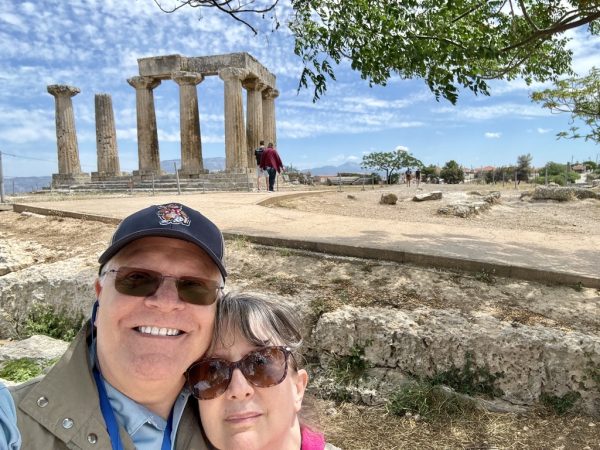
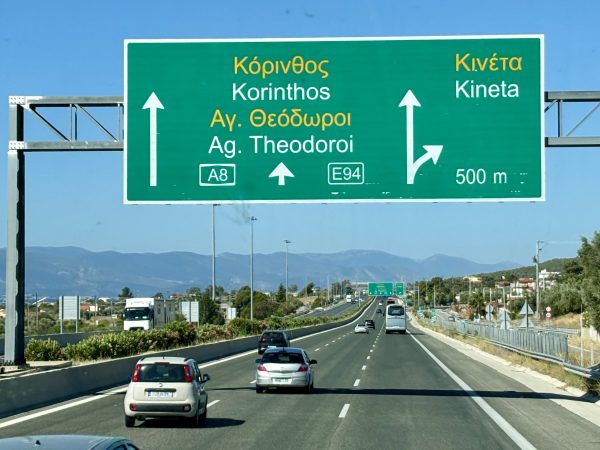
This was a relatively short day, spending the morning in Corinth before returning to our hotel in Athens for the last two nights.

One of the challenges of Corinth turned out to be the outdoor Mass. Our guide, Sofia, found a shady place with some stones we could use as an altar, and some benches we converted into pews. But it was a blustery morning and there was a fair amount of improvisation involved.
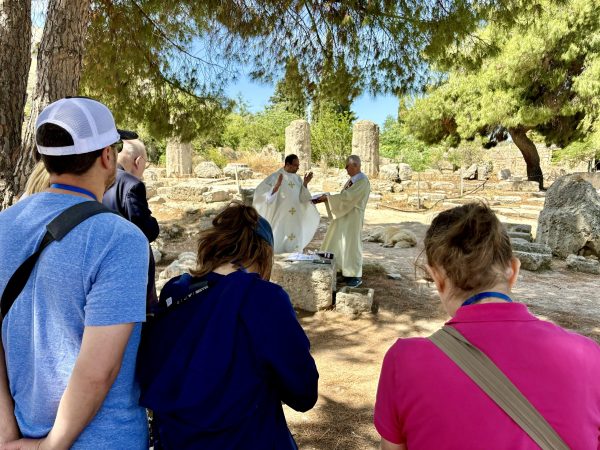

Among other things, I ended up proclaiming the gospel from my iPad mini.
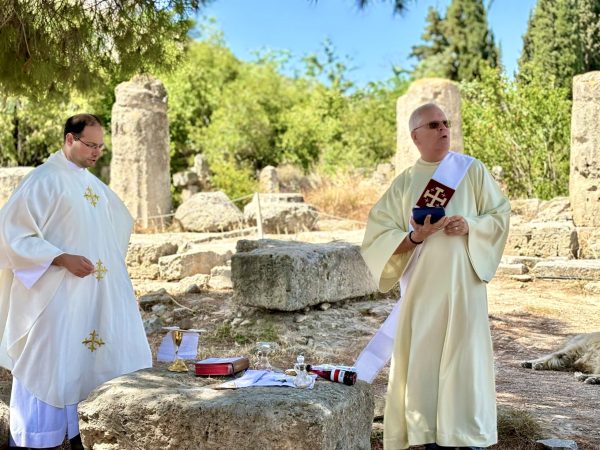
And it was a challenge to keep pages, vessels and vestments from blowing away.
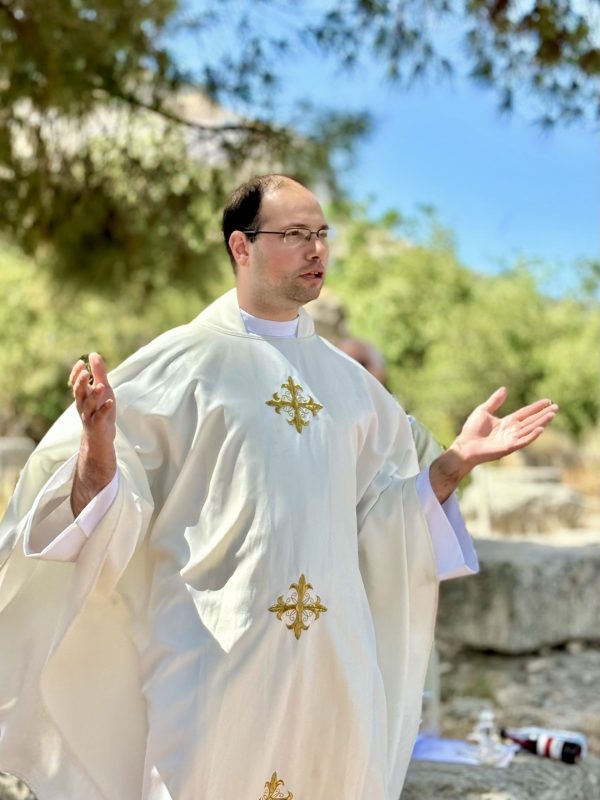

I ended up giving out Communion from a small pyx, using my thumb to keep the hosts from flying away.
But the Mass served as a helpful reminder of how the first Christians gathered as the Body of Christ wherever they could, whenever they could. Our first churches were caves and catacombs. The primitive surroundings in Corinth took us back to our roots.
After Mass, we took a short tour of the archeological site. It reminded me of Philippi. The columns of a pagan temple stand prominently on the horizon.

The city played a significant role in St. Paul’s missionary work:
Corinth was known not only as a thriving city, but also as a center of moral decay, deeply marked by its licentious lifestyle. The city was identified not only by its architectural grandeur or its strategic location on trade routes; it was infamous for a brand of moral corruption so integral to its identity that to be “‘Corinthianized” meant to be lost in the depths of sensual pleasures, to be swept away by a tide of moral decay so powerful that there was no return.
As a result, Corinth earned the nickname “Sin City” in biblical times. The influence of the goddess Aphrodite and the practice of temple prostitution contributed to the city’s immoral reputation.
Despite its sinful culture, Corinth became an important place for the spread of Christianity. The apostle Paul played a crucial role in this, spending about 18 months in Corinth during his second missionary journey. During his time there, Paul established the Corinthian church and faced several challenges in his ministry.
… The apostle Paul played a crucial role in the spread of Christianity in Corinth. During his second missionary journey, Paul spent approximately 18 months in Corinth, establishing the Corinthian church. Initially, Paul preached in the Jewish synagogue but faced opposition, leading him to turn to the Gentiles with the message of the gospel. He met Aquila and Priscilla, who became his ministry coworkers, and together they worked to establish and nurture the Corinthian church.
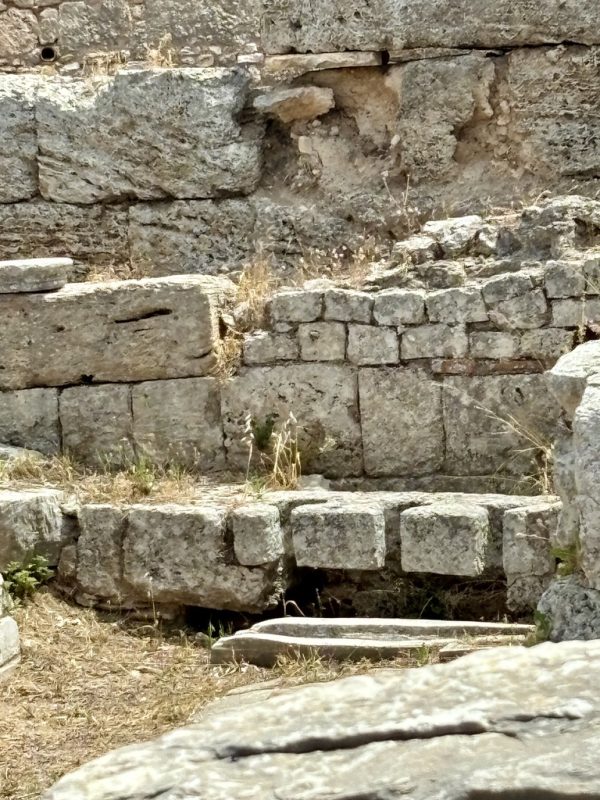
Ancient Greece, to put it gently, was a little different from the world we know. Below, a very public bathroom. Those are toilet seats.
Strolling the city, we also saw some remarkable examples of Corinthian columns and ornaments.

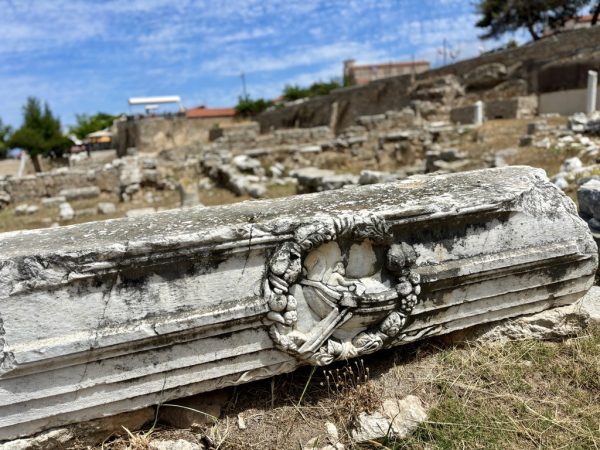
Archeologists are still working to determine the site of the Jewish temple for the city. New artifacts are continuing to be found. In the adjoining museum you can find examples of some striking statues (or what is left of them).

Tomorrow, the last full day for our pilgrimage, we head to historic Athens!
During Mass, we heard Paul’s advice to the young church in Corinth. We can never hear it often enough.
If I speak in human and angelic tongues* but do not have love, I am a resounding gong or a clashing cymbal.And if I have the gift of prophecy and comprehend all mysteries and all knowledge; if I have all faith so as to move mountains but do not have love, I am nothing.
If I give away everything I own, and if I hand my body over so that I may boast but do not have love, I gain nothing.
Love is patient, love is kind. It is not jealous, [love] is not pompous, it is not inflated,d
it is not rude, it does not seek its own interests, it is not quick-tempered, it does not brood over injury,it does not rejoice over wrongdoing but rejoices with the truth.
It bears all things, believes all things, hopes all things, endures all things.Love never fails.