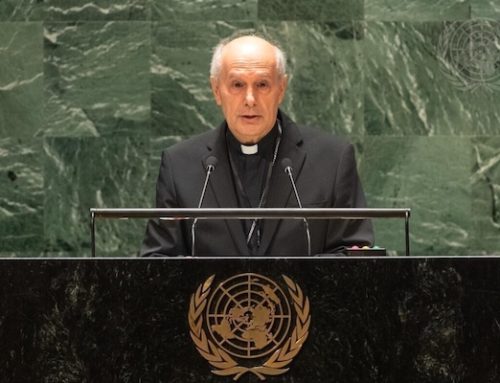

I admit my jaw dropped when I heard his name mentioned and realized that the impossible had not only become possible, it was a reality: an American was elected pope.
For a glimpse into his thinking, check out this interview that Cardinal (then Archbishop) Robert Prevost did with Vatican News a couple years ago, when he was named to head the Dicastery for Bishops:
An Augustinian friar, Robert Francis Prevost was born in the US city of Chicago, and served first as a missionary and later as bishop in Chiclayo, Peru, before being chosen by Pope Francis to succeed Cardinal Marc Ouellet.
In the following interview with Vatican Media, he sketches a portrait of the type of bishop needed today.
Q: What has it mean for you to go from being a missionary bishop in Latin America to leading the dicastery that helps the Pope choose bishops?
Archbishop Prevost: I still consider myself a missionary. My vocation, like that of every Christian, is to be a missionary, to proclaim the Gospel wherever one is.
Certainly, my life has changed a lot: I have the opportunity to serve the Holy Father, to serve the Church today, here, from the Roman Curia. [It is] a very different mission from before, but also a new opportunity to live a dimension of my life, which simply was always answering ‘Yes’ when asked to do a service. With this spirit, I ended my mission in Peru, after eight and a half years as a bishop and almost twenty years as a missionary, to begin a new one in Rome.
Q: Could you offer an “identikit” of a bishop for the Church of our time?
First and foremost, he must be ‘Catholic’: sometimes the bishop risks focusing only on the local dimension. But a bishop should have a much broader vision of the Church and reality, and experience the universality of the Church.
He also needs the ability to listen to his neighbour and seek advice, as well as psychological and spiritual maturity.
A fundamental element of the portrait of a bishop is being a pastor, capable of being close to the members of the community, starting with the priests for whom the bishop is father and brother. To live this closeness to all, without excluding anyone.
Pope Francis has spoken of four types of closeness: closeness to God, to brother bishops, to priests, and to all God’s people. One must not give in to the temptation to live isolated, separated in a palace, satisfied with a certain social level or a certain level within the Church.
And we must not hide behind an idea of authority that no longer makes sense today. The authority we have is to serve, to accompany priests, to be pastors and teachers.
We are often preoccupied with teaching doctrine, the way of living our faith, but we risk forgetting that our first task is to teach what it means to know Jesus Christ and to bear witness to our closeness to the Lord. This comes first: to communicate the beauty of the faith, the beauty and joy of knowing Jesus. It means that we ourselves are living it and sharing this experience.
Q: How important is the bishop’s service of unity around the Successor of Peter in a time when polarisation is also growing in the ecclesial community?
The three words we are using in the work of the Synod—participation, communion, and mission—provide the answer.
The bishop is called to this charism, to live the spirit of communion, to promote unity in the Church, unity with the Pope. This also means being Catholic, because without Peter, where is the Church? Jesus prayed for this at the Last Supper, ‘That all may be one,’ and it is this unity that we wish to see in the Church.
Today, society and culture take us away from that vision of Jesus, and this does so much harm. The lack of unity is a wound that the Church suffers, a very painful one.
Divisions and polemics in the Church do not help anything. We bishops especially must accelerate this movement towards unity, towards communion in the Church.
Q: Can the process for the appointment of new bishops be improved? Praedicate Evangelium states that ‘members of the people of God’ must be involved. Is this happening?
We had an interesting reflection among the members of the Dicastery on this issue. For some time now, not only some bishops or some priests, but also other members of the people of God are being heard. This is very important, because the bishop is called to serve a particular Church. Therefore, listening to the people of God is also important.
If a candidate is not known by anyone among his people, it is difficult—not impossible, but difficult—for him to truly become pastor of a community, of a local Church. So, it is important that the process is a little more open to listening to different members of the community.
This does not mean that it is the local Church that has to choose its pastor, as if being called to be a bishop was the result of a democratic vote, of an almost ‘political’ process. A much broader view is needed, and the apostolic nunciatures help a lot in this. I believe that, little by little, we need to open up more, to listen a little more to the religious, the laity.
Q: One of the novelties the Pope has introduced was to appoint three women among the members of the Dicastery for Bishops. What can you say about their contribution?
On several occasions we have seen that their point of view is an enrichment. Two are religious and one is a laywoman, and often their perspective coincides perfectly with what the other members of the dicastery say; while at other times, their opinion introduces another perspective and becomes an important contribution to the process.
I think their appointment is more than just a gesture on the part of the Pope to say that there are now women here, too. There is a real, genuine, and meaningful participation that they offer at our meetings when we discuss the dossiers of candidates.
Q: The new norms for combating abuse have increased the responsibility of bishops, who are called upon to act promptly and to answer for any delays and omissions. How is this task experienced by the bishop?
We are on a journey with regard to this as well.
There are places where good work has already been done for years and the rules are being put into practice. At the same time, I believe that there is still much to learn.
I am talking about the urgency and responsibility of accompanying victims. One of the difficulties that many times arise is that the bishop must be close to his priests, as I have already said, and he must be close to the victims. Some recommend that it not be the bishop directly who receives the victims; but we cannot close our hearts, the door of the Church, to people who have suffered from abuse.
The responsibility of the bishop is great, and I think we still have to make great efforts to respond to this situation that is causing so much pain in the Church. It will take time. We are trying to work together with the other dicasteries.
I believe it is part of the mission of our dicastery to accompany bishops who have not received the necessary preparation to deal with this issue. It is urgent and necessary that we be more responsible and more sensitive to this.
And below is an interview that Father Prevost did with CNS in 2012, on the subject of St. Augustine.