
He may be one of the most important American saints that most people have never heard of.
His name is Paul Wattson. He was born in Maryland in 1863 and grew up Episcopalian in upstate New York. Young Paul found himself drawn to religious life and became an Episcopal priest. In time, he developed a great interest in the life and spirituality of St. Francis of Assisi. This led him to found an order, the Franciscan Friars of the Atonement, up in Garrison, New York, not far from West Point.
His love for St. Francis deepened and eventually led him to become Catholic.
In an extraordinary move, when he entered the Catholic Church, his entire community of Episcopal friars and nuns, more than 20 people in all, joined with him.
The community’s headquarters sit on hundreds of acres, atop a hill called “Graymoor,” a place Father Paul referred to as the “holy mountain.”
I had the privilege of spending several days there a few years ago, leading a retreat for deacons. I got to learn more about Father Paul Wattson. One moment in his life in particular resonated with me. It happened early one morning in 1904. Father Paul awoke suddenly at 5 in the morning, hearing these words in his soul:
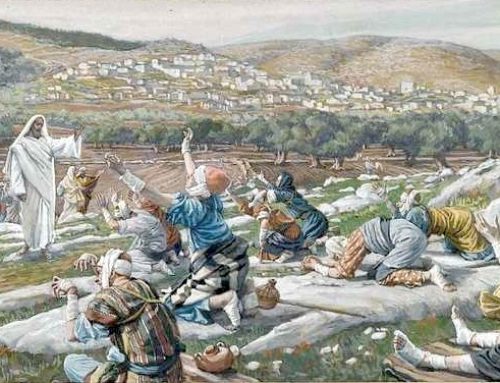
“Gather up the fragments left over, so that nothing will be lost.”
Those are words, of course, from the Gospel we just heard.
That may sound like advice to avoid wastefulness, to not let anything be tossed aside.
And in the context of this great miracle of the loaves and fishes, that is true. What God has given us, through his astounding generosity and love, cannot be taken for granted.
But Father Paul heard another message — one that became central to his life and that should be central to our lives, as well.
It is this:
Every fragment matters.
Every crumb.
Every person.
Every soul.
Nothing, no one, should go to waste. Nothing should be lost.
Father Paul lived that. Probably his greatest legacy is his work for Christian Unity, fervently praying “that all may be one.” He established the Octave for Christian Unity, now observed by Christians around the world.
He also worked not only to save souls, but to save lives.
Part of his legacy endures to this day: the St. Christopher Inn at Graymoor, a homeless shelter dedicated to treating men battling addiction. It is inspired by the words of St. Francis:
“We have been called to heal wounds, to unite what has fallen apart, and to bring home those who have lost their way.”
Gather up the fragments left over…

Screenshot
Who are the fragments in our world today?
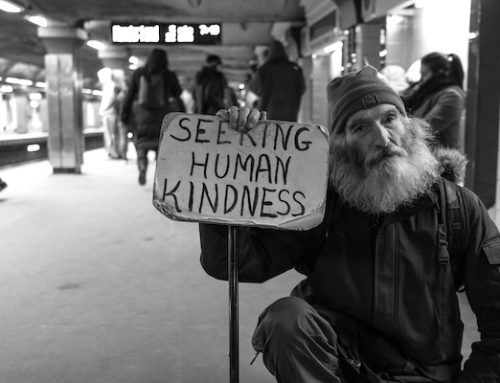
They are those we pass by, begging for money or food or simple human dignity. They are the forgotten, or abandoned, or unloved. The young, the old. The lonely. The sick. The weak.
The fragments are those who are ashamed or marginalized, struggling for dignity or self-worth.
Maybe they feel unsuccessful or unwanted.
Fragments may be people with broken hearts and broken hopes.
Maybe they are facing injustice or bigotry or discrimination simply because they are “different.”
They are our brothers and sisters, our neighbors, our parents, our children.
They are us.
If we are honest about it, all of us at one time or another have felt like fragments.
But Christ spent his life on earth gathering up those fragments, saving them, healing them. He told his disciples to do the same.
Nothing, and no one, should be wasted, forgotten, discarded or lost. No one should feel unwanted.
That includes, in a special way, the unborn.
You will be hearing more in the days ahead about Amendment 4, on the ballot in Florida this November. I wanted to mention it this weekend, in connection with this reading. I’ll have more to say in a future homily.
There are many reasons to oppose this law, but today one stands out: this amendment mocks the message of this gospel. It says, in effect, that the smallest, the most vulnerable, the most defenseless — the unborn — can be discarded.
Like fragments.
“Gather up the fragments left over…”
I’ll say it again: Nothing, no one, should be wasted, forgotten, discarded, lost.
Father Paul Wattson saw dignity and purpose everywhere, in every one. Over the years, he rescued so many. He went on to found the Catholic Medical Mission Board, which collects used equipment for hospitals in mission countries. He set up a charitable organization called the Union That Nothing Be Lost, created, quote, “to see that nothing would be lost in tending to the sick and the poor and bringing the Kingdom of God to others.”
He was also the co-founder of the papal agency I worked for in New York, Catholic Near East Welfare Association, CNEWA.
Following the example of Jesus in this gospel, Father Paul held nothing back. He cared for anyone. He loved without limits.
His life challenges all of us ask: do we? Are we holding back? Are we willing to love that generously?
This is what saints are made of.
On February 8, 1940, the day after Ash Wednesday, Father Paul suffered a heart attack and died at Graymoor. He was 77. In 2015, the cause for his canonization was opened. He is now known as a “Servant of God,” as the Church awaits a miracle that could bring about his beatification.
Some would say his miracles are everywhere today — in all the lost he helped to find, all the fragments he salvaged, all scattered parts he collected to try and bring unity to God’s broken church.
He carried the words of this gospel in his heart:
“Gather up the fragments left over, so that nothing will be wasted.”
In a few moments, we will receive a fragment — a sliver of bread which is the Body of Christ. Our Lord and our God. It reminds us what a fragment can become.
Receive the wonder and the beauty of something so great contained in something so small.
Perhaps it is God’s way of reminding us that he is found where we least expect him — often among the least.
Even a fragment, something so small, can be part of a miracle.