
“Strive to enter through the narrow gate.”
Scholars will tell you that this passage is where we get the familiar phrase, to “walk the straight and narrow.” Maybe we think it means to follow the rules and try to be good. You can even find it defined in Webster’s online dictionary, which says it means “the way of living that is honest and morally proper.”
It sounds simple. But it isn’t. It’s complicated. And it’s hard.
“Strive to enter through the narrow gate.”
So just what does that mean? How do we do it?
Well, we’ve been hearing the answer every week this summer.
Look back at the readings. Week after week, in St. Luke’s Gospel, Jesus has been telling us what the narrow gate is, and what we need to do to enter it.
For one thing, we don’t need to be skinny. A new diet won’t help.
We need to be brave. And beyond that, we need to want, more than anything, to be holy.
What is the narrow gate?
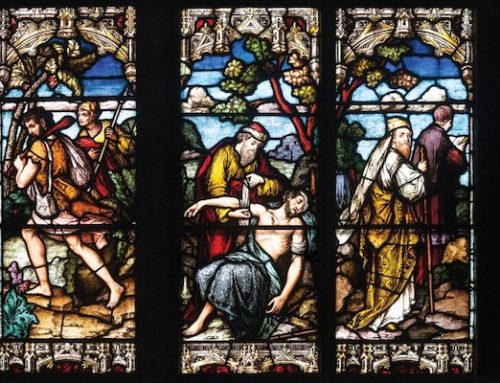
The narrow gate is way of the Samaritan who realizes the broken, bleeding man by the side of the road — a man he doesn’t know, a man who might even despise him — is his neighbor and that he is called to love him and care for him.
The narrow gate is the way of the woman named Mary who sits at the feet of the Lord to listen, and learn, and love — and does it even though it makes her sister angry.
The narrow gate is the way of praying as Jesus taught — praying to forgive, praying for God’s will to be done, praying to never tire of asking God for his grace.
The narrow gate is the way of those who build barns to hold the treasure that is important to God, instead of the treasure that is important to the world.
It’s all there. The lessons have been laid out for us. It’s worth asking ourselves: we come here week after week, but have we been paying attention?
There’s one part of this Gospel that really struck me. It’s in the parable, when people stand outside the master’s door and beg to be let in. “We ate and drank in your company and you taught in our streets!”
The reality is: that could describe any of us here today. Every weekend, we eat in Christ’s company, we dine here at the table of the Lord, we listen to him teach, we hear his Word.
But then what?
In the parable, the Master is unmoved. He says, “I don’t know where you are from.” Something was missing.
The Gospel makes clear: just showing up isn’t enough.
We need to do more.
We need to BE more.
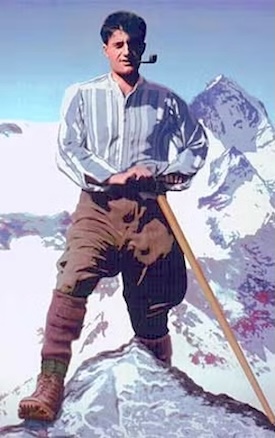
I was reminded of someone whose name you’ll be hearing more in the days ahead: Pier Giorgio Frassatti. Pier was born in Turin, Italy, in 1901. He grew up to be an extraordinary young man, with a deep love of the Lord and a passion for justice and mercy. “Charity is not enough,” he said. “We need social reform.” He believed in working to make a culture built on the Gospel of Jesus Christ. A culture of mercy and compassion, justice and peace.
He was also a man of irrepressible joy, with a taste for adventure. Pier loved mountain climbing. He organized trips into the mountains with his friends, and he made them opportunities for prayer and conversations about faith.
Through it all, he was striving to enter through the narrow gate, to live Christ’s teaching daily. One biography said “Pier embodied Christ’s love in action. He would give away his bus fare or even his own coat to help those in need. He saw the face of Christ in every suffering person, recognizing their inherent dignity.”
Pier had many gifts and throughout his life he felt called to do more, to be more.
But the one gift he didn’t have was the gift of time.
In his early 20s, Pier was stricken with polio. Some believe it may have happened because of his frequent contact with the poor and the sick. He died tragically young, at the age of 24. Days after his death, friends found a simple note he wrote on a photograph of himself on a mountain. It was from his last climb. The note said: “Verso L’Alto”, which means “to the heights.”
On the day of his funeral, thousands turned out and filled the streets around his church. Many of them, most of them, were poor. Over the years, his reputation for holiness spread. The movement began to have him declared a saint. When workers went to his grave to disinter his body, they were stunned. He was incorrupt. He looked the same as he did the day he was buried.
Next month, 100 years after his death, he will be canonized and become Saint Pier Giorgio Frassati. He is considered the patron of young people, of athletes, and of “ordinary people,” people like you and me, all of us striving to enter through the narrow gate, working to climb “to the heights.”
Blessed Pier understood something that all of us need to learn, and all of us need to live. It is part of this Sunday’s message.
Just showing up isn’t enough.
A commentator once noted: A narrow gate is big enough for just one person and that person is Jesus Christ. Entering through him demands more.
More devotion. More sacrifice. More love.
As we come forward to receive the Eucharist this morning, let us ask Blessed Pier to walk with us, and climb with us, and help us enter through the narrow gate.
There is already a church in the United States, in South Carolina, named for Blessed Pier Giorgio Frassatti … it will soon have its name changed to Saint Pier Giorgio Frassatti.
On its website you will find this prayer:
Heavenly Father,
Give me the courage to strive for the highest goals,
to flee every temptation to be mediocre.
Enable me to aspire to greatness, as Pier Giorgio did,
and to open my heart with joy to Your call to holiness.
Free me from the fear of failure.
I want to be, Lord, firmly and forever united to You.
Grant me the graces I ask You through Pier Giorgio’s intercession,
by the merits of Our Lord Jesus Christ.
Amen..