
When I was growing up, my mother had an unwritten rule: the day after Christmas, if you haven’t done it yet, you have to start your thank-you notes. You couldn’t just play with your new Hot Wheels or G.I. Joe. There was work to do. By that evening, I’d hear, “Have you written your note to Aunt Agnes and Uncle Joe? Did you write your note to your grandmother?”
So, reading this scripture, I’m sure my mother would have had a few words to say to nine of the lepers in today’s Gospel.
What we hear today is very much a lesson in gratitude — in fact, it is the Gospel that is suggested in the United States for use during Mass on Thanksgiving Day.
But to think it is just about giving thanks is to miss the treasure buried in this scripture. This isn’t merely a lesson in etiquette.
Dig a little deeper into this episode and you find it is fundamentally about something that lies at the heart of the Good News — beginning with the preaching of John the Baptist and continuing to this very day.
Put simply: This Gospel about the lepers is a story about change — dramatic, heart-stopping, life-altering change. It reminds us that an encounter with Jesus Christ can change everything.
Of course, there is the change of the lepers’ skin. But the lesson here is more than skin-deep.
I think this Gospel teaches that there are three distinct ways we change – and are changed — because of Christ.
First, it teaches the importance of changing attitudes. Changing our expectations. Changing how we see others.
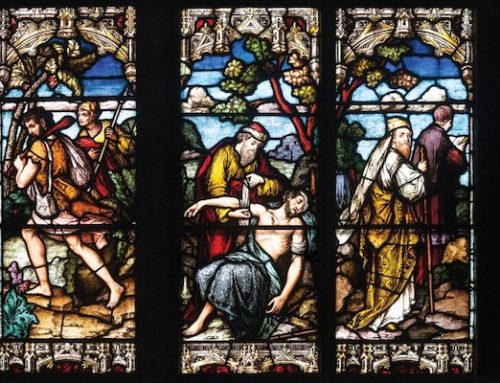
In many ways, this echoes the parable of the Good Samaritan that we heard in Luke’s Gospel a few weeks ago. In Jesus’s day, as you know, Samaritans were despised.
Here, as in that famous parable, Luke shows us once again that the Samaritan is the one who is discovered to be good. The Samaritan does the right thing, the humble thing. He realized the miraculous effect that Jesus had on his life — and, because of that, on his standing in the world. Think of it. The man who had once been a leper would no longer be considered unclean, one to be shunned. He would no longer be an outcast. He would have dignity. He wouldn’t have to beg for pity or cry out for food. He would have a future.
The reality of that must have been overwhelming. So instead of continuing his way to the temple, he went back and said to Christ, “Thank you.”
Only this one, the one that the people of his time hated, had the humility to bow to God in gratitude.
Sometimes there is more to people than we realize. Even those who are demonized or despised can be capable of extraordinary acts of goodness. They can stand before us as examples of faith.
So it was here.
Jesus offered his followers a truly “teachable moment,” teaching them — and us — to not be so quick to judge. The moral of the story? Even Samaritans can teach us. Even they can be saved.
So, begin with a change in attitude. Prepare to be surprised by what others are capable of.
Secondly, this Gospel is about changing priorities. Before all else, the Samaritan took the time and trouble to express gratitude, to thank God for the unexpected blessing he received.
I have a tee shirt at home that says on the front, “But first, let me thank God.” I wear it as a reminder to myself — and to anyone I happen to meet — that we need to live every day, every moment, in a spirit of thanksgiving, an “attitude of gratitude.”
Blessed Solanus Casey used to tell people, “Thank God ahead of time.” Whether we realize it or not, our Father loves us so much, he is constantly showering us with gifts. The gift of life. The gift of faith. The gift of another day to grow, to change, to strive to become the holy people he created us to be. Ours is a faith rooted in second, third, fourth and fifth chances. We should never take that for granted. God’s mercy makes all things possible, even our salvation.
So change priorities. Thank God ahead of time.
Finally, the episode is — literally — about changing direction.
Remember the Magi. In their story, from Matthew’s Gospel, we heard that after learning about Herod in a dream, they returned to their homeland “by another route.” It is the first time we hear about lives being redirected because of Jesus. It won’t be the last.
This encounter with the lepers is another example.
The Samaritan stopped where he was going and went another way. He returned to Jesus. He couldn’t continue on his journey without going back to the one who had made it possible.
Maybe this was a moment of conversion.
But it was certainly a moment of redirection — almost, in a sense, a moment of reconciliation. It reminds us of the sacrament of confession. Healed of sin, the penitent prays the Act of Contrition and vows to “firmly resolve with the help of grace…to confess my sins, to do penance and to amend my life.” Was this idea burning in the heart of the healed leper? We’ll never know. But in his detour, we see a change in direction that should say to all of us: “Christ can change how we go through life.”
And isn’t that the great message of the Gospel?
Changing attitudes.
Changing priorities.
Changing direction — the way we live, the way we are going.
The early Christians used to refer to their new faith as “The Way” — meaning, they were following the Way of Jesus Christ.
This scene with the lepers shows how that begins. With healing. With grace. With change.
Nine were changed. Only one realized this was a chance to change direction.
This is the Christian story, our story. It is the great prayer of our lives.
As we prepare to receive Christ in the Eucharist — the very word, by the way, that means “thanksgiving” — let us not only give thanks. Let us pray to become the people God made us to be. To be renewed. To grow. To be changed by this encounter with Christ.