It’s almost time.
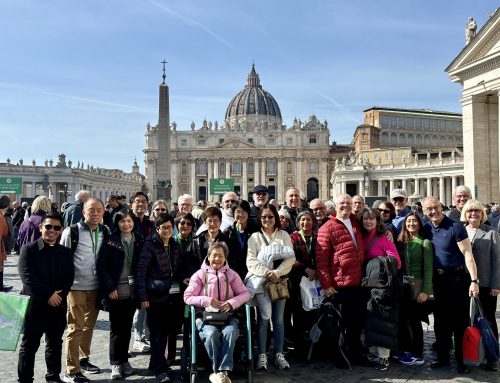
Next week, I depart for Italy with a group of nearly 30 pilgrims, making our way to Venice, Padua, Assisi and, finally, Rome to take part in the Jubilee of Deacons. Reading over the decree on the Jubilee, I found some details for gaining an indulgence that, I suspect, aren’t widely known. These are things all of us can (and should!) do anytime.
First, you can travel:
The faithful, pilgrims of hope, will be able to obtain the Jubilee Indulgence granted by the Holy Father if they undertake a pious pilgrimage:
to any sacred Jubilee site: by devoutly participating in Holy Mass (where the liturgical norms allow for it, the Mass of the Jubilee might fruitfully be chosen, or one of the Votive Masses: for Reconciliation, for the Remission of Sins, for the Promotion of Charity or to Foster Harmony); a ritual Mass for the conferral of the sacraments of Christian Initiation or the Anointing of the Sick; or any of the following: a celebration of the Word of God; the Liturgy of the Hours (office of readings, lauds, vespers); the Via Crucis; the Marian Rosary; the recitation of the Akathist hymn; a penitential celebration, which ends with the individual confessions of the penitents, as established in the Rite of Penance (form II);
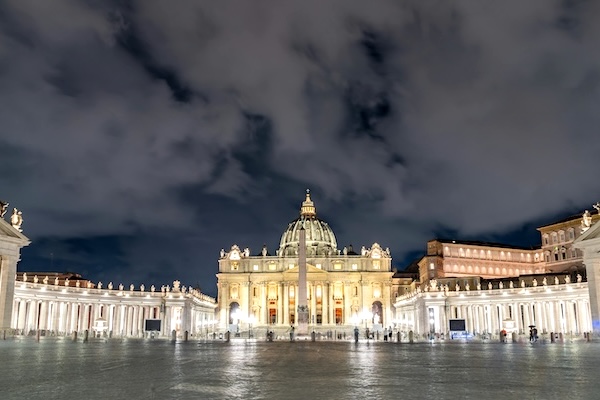
in Rome: by visiting at least one of the four Major Papal Basilicas: St. Peter’s in the Vatican, the Archbasilica of the Holy Saviour (St John Lateran’s), Saint Mary Major’s, and St. Paul’s Outside the Walls;
in the Holy Land: by visiting at least one of the three basilicas: the Basilica of the Holy Sepulchre in Jerusalem, the Basilica of the Nativity in Bethlehem, or the Basilica of the Annunciation in Nazareth;
in other ecclesiastical areas: by visiting the Cathedral or other church or sacred place designated by the local Ordinary. Bishops will take into account the needs of the faithful as well as the opportunity to reinforce the concept of pilgrimage with all its symbolic significance, so as to manifest the great need for conversion and reconciliation.
But you don’t need to leave home. You can strive to be a “tangible sign of hope” for others. Specifically, it mentions performing an act of charity for souls in Purgatory:
Despite the rule that only one plenary indulgence can be obtained per day (cf. Enchiridion Indulgentiarum, IV ed., norm. 18, § 1), the faithful who have carried out an act of charity on behalf of the souls in Purgatory, if they receive Holy Communion a second time that day, can obtain the plenary indulgence twice on the same day, applicable only to the deceased (this must take place within a Eucharistic celebration; see can. 917 and the Pontifical Commission for the authentic interpretation of the CIC, Responsa ad dubia, 1, 11 July 1984). Through this double act, a praiseworthy exercise of supernatural charity is carried out, through that bond by which the faithful still journeying on this earth are united in the mystical Body of Christ, with those who have already completed their journey, by virtue of the fact that “the Jubilee indulgence, thanks to the power of prayer, is intended in a particular way for those who have gone before us, so that they may obtain full mercy” (Spes non confundit, 22).
In a special way “during the Holy Year, we are called to be tangible signs of hope for those of our brothers and sisters who experience hardships of any kind” (Spes non confundit, 10). Therefore, the Indulgence is also linked to certain works of mercy and penance, which bear witness to the conversion undertaken. The faithful, following the example and mandate of Christ, are encouraged to carry out works of charity or mercy more frequently, especially in the service of those brothers and sisters who are burdened by various needs. More especially, they should rediscover these “corporal works of mercy: to feed the hungry, give drink to the thirsty, clothe the naked, welcome the stranger, heal the sick, visit the imprisoned, and bury the dead ” (Misericordiae vultus, 15) and rediscover also “the spiritual works of mercy: to counsel the doubtful, instruct the ignorant, admonish sinners, comfort the afflicted, forgive offences, bear patiently those who do us ill, and pray for the living and the dead” (ibid.).
In this way, the faithful will be able to obtain the Jubilee Indulgence if they visit, for an appropriate amount of time, their brothers and sisters who are in need or in difficulty (the sick, prisoners, lonely elderly people, disabled people…), in a sense making a pilgrimage to Christ present in them (cf. Mt 25, 34-36) according to the usual spiritual, sacramental and prayer conditions. The faithful can repeat these visits throughout the Holy Year, even daily, acquiring a plenary indulgence each time.
And then there are acts of penance — notably abstaining from “futile distractions” (including social media) and supporting life “in all its phases, but also supporting the quality of life of abandoned children, the needy and migrants”:
The Jubilee Plenary Indulgence can also be obtained through initiatives that put into practice, in a concrete and generous way, the spirit of penance which is, in a sense, the soul of the Jubilee. In particular the penitential nature of Friday can be rediscovered through abstaining, in a spirit of penance, at least for one day of the week from futile distractions (real but also virtual distractions, for example, the use of the media and/or social networks), from superfluous consumption (for example by fasting or practicing abstinence according to the general norms of the Church and the indications of the Bishops), as well as by donating a proportionate sum of money to the poor; by supporting works of a religious or social nature, especially in support of the defense and protection of life in all its phases, but also by supporting the quality of life of abandoned children, young people in difficulty, the needy or lonely elderly people, or migrants from various countries “who leave their homelands behind in search of a better life for themselves and for their families” (Spes non confundit, 13); it can also be obtained by dedicating a reasonable portion of one’s free time to voluntary activities that are of service to the community or to other similar forms of personal commitment.
There’s much we can do — and in the days leading up to Lent, it might spark some ideas for that penitential season, too.