A few people noticed something different last weekend, and Vatican News explains:
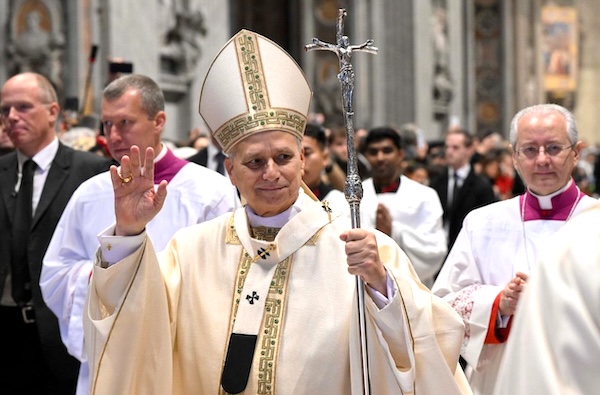
On 6 January, the Solemnity of the Epiphany and the closing of the Holy Door of Saint Peter’s Basilica, Leo XIV made use of a new pastoral staff. As explained by the Office for the Liturgical Celebrations of the Supreme Pontiff, the staff “stands in continuity with those used by his predecessors, uniting the mission of proclaiming the mystery of love expressed by Christ on the Cross with its glorious manifestation in the Resurrection.”
“The Paschal Mystery, the gravitational center of the apostolic proclamation, thus becomes a motive of hope for humanity, because death no longer has any power over mankind, since what Christ has assumed He has also redeemed,” reads the note. The pastoral staff of Pope Leo XIV “presents Christ no longer bound by the nails of the Passion, but with His glorified body in the act of ascending to the Father. As in the appearances of the Risen Lord, He shows His wounds to His own as luminous signs of victory which, while not erasing human suffering, transfigure it into the dawn of divine life.”
The Office for the Liturgical Celebrations further recalls that the pastoral staff, as an episcopal insignia, “was never among the proper insignia of the Roman Pontiff. From the High Middle Ages, Popes made use of the ferula pontificalis, an insignia indicating their spiritual authority and governance. Although the form of the ferula is not precisely defined, it was probably a staff surmounted by a simple cross. Popes received this insignia after their election, when they took possession of their Cathedra in the Basilica of Saint John Lateran.”
The use of the ferula, however, “was never part of papal liturgy, except on certain occasions, such as the opening of the Holy Door, to knock three times upon its panels, or during the consecration of churches, to trace on the floor the Latin and Greek alphabets prescribed by the rite.”
It was Pope Saint Paul VI who, on 8 December 1965, on the occasion of the closing of the Second Vatican Council, used a silver ‘pastoral staff’ bearing the figure of the Crucified Christ.
The sculptor Lello Scorzelli, to whom the work was commissioned, sought thereby to express the vocation of the Apostle Paul—whose name the Pope had chosen to bear—namely, that of being a witness and herald of Christ crucified (cf. 1 Cor 2:2).
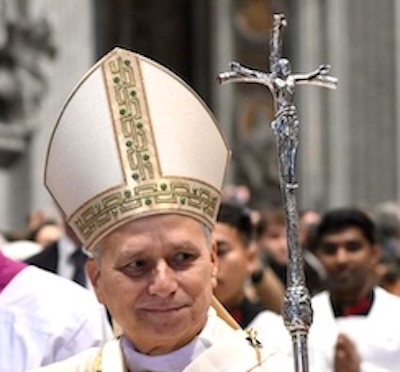
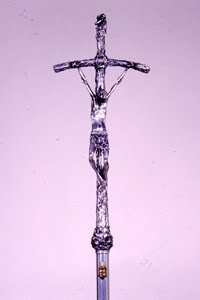
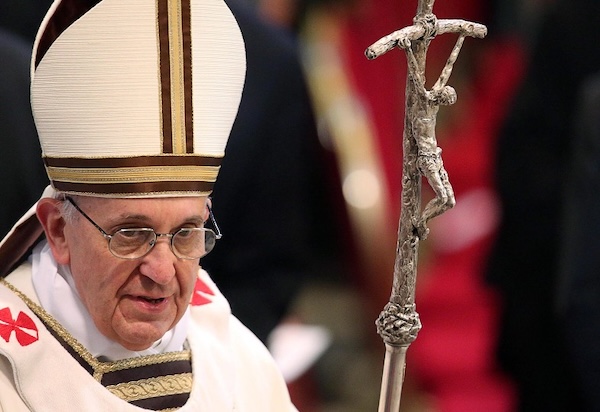
The staff of Paul VI was also used often by Pope Francis.
It strikes me that the new staff also reflects a recurring theme in Leo’s young papacy: hope.
As I note in my new book:
Pope Leo has begun his papacy by continuing the theme that his predecessor proclaimed for the Jubilee, refocusing hearts and minds on one distinct message, hope.
A few weeks into his papacy, he recorded a video message for young people gathered at his home turf in Chicago’s White Sox stadium:
I’d like to say that you are the promise of hope for so many of us. The world looks to you as you look around yourselves and say: we need you, we want you to come together to share with us in this common mission, as Church and in society, of announcing a message of true hope and of promoting peace, promoting harmony, among all peoples…
“Hope does not disappoint”, Saint Paul tells us in his letter to the Romans (5,5). When I see each and every one of you, when I see how people gather together to celebrate their faith, I discover myself how much hope there is in the world…
…Tying his preaching to the Holy Year, Leo also delivered a series of talks on the subject of hope as the catechesis of his General Audience — even finding a message of hope in moments such as Christ’s agony in the Garden of Gethsemane:
The way that Jesus exercised his freedom in the face of death teaches us not to fear suffering, but to persevere in confident trust in God’s providential care. May our lives always be marked by this hope, born of the knowledge that if we surrender to God’s will and freely give our lives in love for others, the Father’s grace will sustain us in every trial and enable us to bear abundant fruit for the salvation of our brothers and sisters.