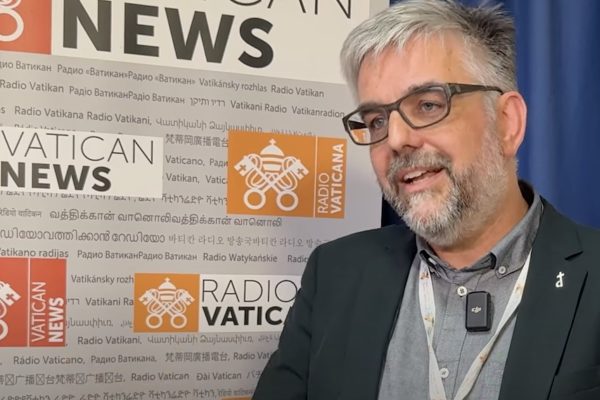
Deacon Geert De Cubber from Belgium is the only Latin Rite permanent deacon participating at the Vatican Synod, and he offered comments last week as part of an intervention:
Following his prepared remarks, Deacon Geert De Cubber – a witness to the synodal process, theologian, former journalist, permanent deacon of the diocese of Ghent (Belgium), episcopal delegate for catechesis and youth and family pastoral work, as well as husband and father, received the most questions. Deacon De Cubber is the only permanent deacon from the Latin Church taking part in the Synod; two other deacons, one from the Syriac Church and a transitional deacon from the Melkite Church, are also present in the Assembly.
Deacon De Cubber repeated what he had said in the Synod hall: the deacon is a ‘bridge-builder’ in the family, with other families, in the community, and also with wider society. This, he said, “can be really useful in a secularised society” like Belgium, which the Pope visited at the end of September after a brief stop in Luxembourg.
The deacon’s task, De Cubber added, is to go out and “go where the Church does not go, to those who have no voice and are marginalised by the Church itself and by society, and bring them back into the Church.”
In a Church where the faithful are often tired and elderly, and where “if we do not walk in a synodal way the Church will not survive,” the Belgian deacon sought to bring synodality to the youth, uniting the youth ministries of all the Flemish-speaking dioceses in the effort.
Prompted by a journalist’s question, he admitted that deacons could have been better represented at the synod, and that he knows that deacons in the US, for instance, “where the ministry is very strong,” are “not very happy that we are so few.”
He thus proposed a post-synodal meeting of deacons in the future, as was done this year with parish priests.
“Being a deacon,” De Cubber concluded, “is not for me at all a preparation for the priesthood, I do not have this vocation. Ours is a ministry exclusively of service.”