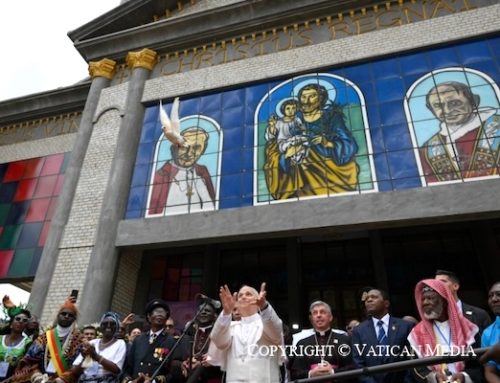

TIME magazine recently sat down with Elise Ann Allen, who has known and written about the man we now call Pope Leo for nearly a decade. She’s just published a new biography of him and in this interview she offered some insight into Leo, his personality, and his approach to his mission.
You first met the Pope when you were a young journalist, covering a sex scandal in Peru. What struck you about him then?
He did not seem guarded in any way. When you’re talking to clergy or bishops about sexual abuse, you’re often met with a wall, and that was not the case with him. Also, the Catholic Church had not started talking about abuses of power yet. It was mostly concentrated on sexual abuse of minors, not even adults. But he independently started talking about abuses of power and of conscience, the power differential between clergy and the people under their care.
Having now spent considerably more time with him, has anything changed about that first impression you had of him?
No. When I sat down with him for the two conversations that we had for the book, he did not ask to see any questions in advance. He did not ask to read the final transcript afterwards. He answered every question that I asked. His style is the same. What is changing, perhaps, is his way of talking about issues. He’s trying to find his voice as Pope. I think it was hard for him to believe still at the beginning. In Africa just now, he really just threw himself in. You could see him on a whole new level.
What would surprise most people about Pope Leo?
His complete and utter sincerity. There’s nothing calculated about the man. If you’re looking at Pope Francis, for example, he was somebody that was ultimately a very political creature; he thought in a very political way. And he made very strategic decisions. I don’t think Leo is like that. What you see is what you get with him. I don’t know that people understand that, especially after 12 years of Pope Francis. He’s just super chill; he has a great sense of calm. He reads a lot, he’s got all the pieces in his head. He’s saying, OK, let’s just see what happens, and I’ll try to find my way forward.
Is that what you would say is the key difference between him and Francis? Or are there others?
Their personalities are very different. Their style is very different. Ultimately, their priorities are very similar: issues of poverty and justice. Francis was very impulsive. Leo is very reflective. He’s a mathematician. He’s a canonist. He thinks very precisely. Francis was very shoot-from-the-hip. Leo prefers to be slow and steady, to take his time, to reflect, to listen, and then he’ll find his way forward. I think he’ll go even further than Francis did, especially in some of the social issues when you’re talking about poverty or justice.