From Vatican News:
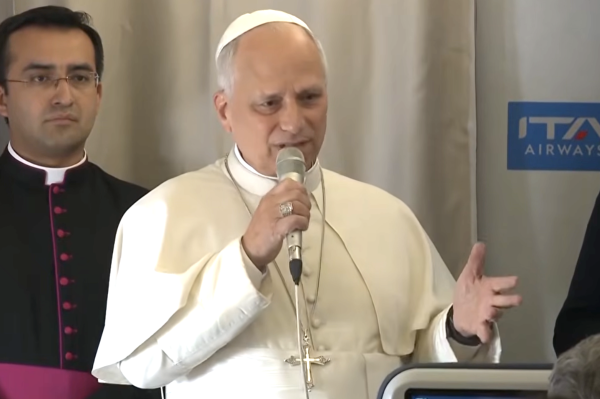
Pope Leo XIV has concluded his long Apostolic Journey in Africa. Aboard the flight from Malabo—the final stop in Equatorial Guinea—back to Rome, he answered questions from five of the roughly 70 journalists who followed the international visit.
He addressed the issues of war, the US-Iran negotiations, migration, the death penalty, and the blessing of homosexual couples.
The Pope began with a reflection on the experience he had just concluded in four African nations.
Below is a working English transcription and translation of the press conference:
[Pope Leo XIV, in Italian:]When I travel, I speak for myself, but today as Pope, Bishop of Rome, it is above all a pastoral Apostolic Journey to meet, accompany, and get to know the People of God.
Very often the interest expressed is more political: ‘What does the Pope say about this or that issue? Why doesn’t he judge the government in one country or another?’ And there are certainly many things to say. I have spoken about justice, and those issues are there.
But that is not the first word: the journey should be understood above all as an expression of the desire to proclaim the Gospel, to announce the message of Jesus Christ, which is a way of drawing close to the people in their happiness, in the depth of their faith, but also in their suffering.
There, it is clear that very often it is necessary to make comments or to look for ways to encourage people themselves to take responsibility for their lives. It is also important to speak with Heads of State, to encourage a change of mindset or greater openness to thinking about the common good, and to consider issues such as the distribution of a country’s resources. In the talks we had, we did a bit of everything, but above all we saw and met the people with this enthusiasm.
<edit>
Ignazio Ingrao (Tg1): Your Holiness, thank you for this journey rich in encounters, stories, and faces. At the peace meeting in Bamenda, Cameroon, you described an upside-down world where a handful of tyrants risk destroying the planet. Peace, you said, must not be invented but welcomed. Negotiations over the Iran conflict are in chaos, with heavy effects on the global economy. Do you hope for regime change in Iran, given that civil society and students also took to the streets in recent months, and there is global concern about the nuclear race? What appeal do you make to the United States, Iran, and Israel to break the deadlock and stop the escalation? And should NATO and Europe be more involved?
[Pope Leo XIV, in Italian:] I would like to begin by saying that we must promote a new attitude and a culture of peace. Very often, when we assess certain situations, the immediate response is that we must go in with violence, with war, with attacks.
What we have seen is that many innocent people have died. I have just seen a letter from families of children who were killed on the first day of the attack. They speak about how they have lost their children, who died in that event. The issue is not whether there is regime change or not; the issue is how to promote the values we believe in without the death of so many innocent people.
<edit>
Rather, I would encourage the continuation of dialogue for peace, that all sides make every effort to promote peace, remove the threat of war, and respect international law. It is very important that innocent people are protected, as has not happened in several places.
I carry with me a photo of a Muslim child who, during the visit to Lebanon, was waiting there with a sign saying “Welcome Pope Leo.” He has been killed in this final phase of the war. There are many human situations, and I think we must be able to think in these terms.
As a Church—I repeat—as a pastor, I cannot be in favor of war. And I would like to encourage everyone to make efforts to seek answers that come from a culture of peace, not hatred and division.
<edit>
Verena Stefanie Shälter (Ard Rundfunk): Holy Father, congratulations on your first papal trip to the Global South. We saw a lot of enthusiasm and even euphoria; I can imagine that was very moving for you as well. I would like to know how you assess the decision of Cardinal Reinhardt Marx, Archbishop of Munich and Freising, that he gave permission to the blessing of same-sex couples in his diocese, and in light of different cultural and theological perspectives, especially in Africa, how do you intend to preserve the unity of the global Church on that particular matter?
[Pope Leo XIV, in English:] First of all, I think it’s very important to understand that the unity or division of the Church should not revolve around sexual matters. We tend to think that when the Church is talking about morality, that the only issue of morality is sexual. And in reality, I believe there are much greater, more important issues, such as justice, equality, freedom of men and women, freedom of religion, that would all take priority before that particular issue. The Holy See has already spoken to the German bishops.
The Holy See has made it clear that we do not agree with the formalized blessing of couples, in this case, homosexual couples, as you asked, or couples in irregular situations, beyond what was specifically, if you will, allowed for by Pope Francis in saying all people receive blessings.
When a priest gives a blessing at the end of Mass, when the Pope gives a blessing at the end of a large celebration like the one we had today, they are blessings for all people. Francis’ well-known expression ‘Tutti, tutti, tutti’ is an expression of the Church’s belief that all are welcome; all are invited; all are invited to follow Jesus, and all are invited to look for conversion in their lives.
To go beyond that today, I think that the topic can cause more disunity than unity, and that we should look for ways to build our unity upon Jesus Christ and what Jesus Christ teaches. So that’s how I would respond to that question.
Anneliese Taggart (Newsmax TV): Holy Father, thank you very much. You have spoken on this trip about how people hunger and thirst for justice. It was just reported this morning that Iran has executed yet another one of the members of the opposition, and this comes as it has been said that the regime has also publicly hanged multiple other people, as well as murdered thousands of its own people. Do you condemn these actions, and do you have any message to the Iranian regime?
[Pope Leo XIV, in English:]I condemn all actions that are unjust. I condemn the taking of people’s lives. I condemn capital punishment. I believe that human life is to be respected and that all people—from conception to natural [death, ed.]—their lives should be respected and protected.
So when a regime, when a country takes decisions which takes away the lives of other people unjustly, then obviously that is something that should be condemned.