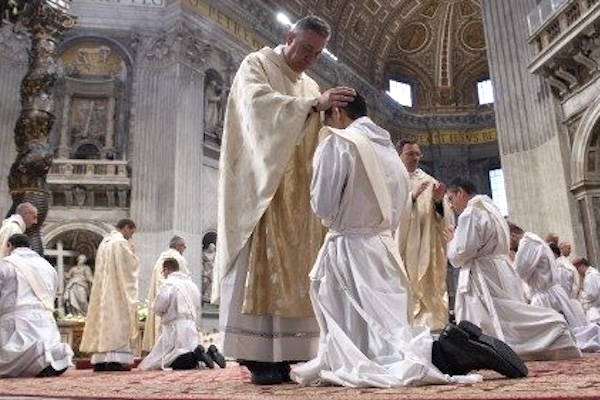
Pope Leo issued an Apostolic Letter this morning (Monday) on priestly ministry, “A fidelity that generates the future.” Vatican News noted:
Fidelity expressed in humble service to every person, in constant dialogue with God and His People through ongoing formation, in the context of fraternity among priests and with the whole Church, in the missionary and synodal spirit that transcends any temptation to self-celebration: these are some of the priorities that Leo XIV wishes to see intensified in priestly life, contained in the Apostolic Letter Una fedeltà che genera future (“A fidelity that generates the future”) signed on the feast of the Immaculate Conception and released today, 22 December.
The Letter was occasioned by the sixtieth anniversary of the conciliar decrees Optatam totius and Presbyterorum ordinis: documents the Pope said, “that constitute a milestone in theological reflection on the nature and mission of pastoral ministry and preparation for it,” and that retain their “great newness and relevance.”
And the Holy Father made a point in the letter of mentioning permanent deacons:
At a time of great instability, all ordained ministers are called to live in communion by returning to what is essential and being close to people, in order to preserve the hope that takes shape in humble and concrete service. In this context, the ministry of the permanent deacon, configured to Christ the Servant, is a living sign not of a superficial love but one that bends down, listens and gives generously. The beauty of a Church made up of priests and deacons who cooperate, united by the same passion for the Gospel and attentiveness to those most in need, becomes a shining witness of communion. According to the words of Jesus (cf. Jn 13:34-35), it is from this unity, rooted in mutual love, that the Christian proclamation receives credibility and strength. For this reason, the diaconal ministry, especially when lived in communion with one’s family, is a gift to be understood, valued and supported. The discreet but essential service of men dedicated to charity reminds us that the mission is not accomplished with grand gestures, but by a united passion for the Kingdom and daily fidelity to the Gospel. (Emphasis added)
He also notes:
The ministry of the priest must move beyond the model of exclusive leadership, which leads to the centralization of pastoral activities and the burden of all responsibilities entrusted to him alone. Instead, the ministry should move toward an increasingly collegial leadership, with cooperation between priests, deacons and the entire People of God resulting in mutual enrichment that is the fruit of the various charisms bestowed by the Holy Spirit. As Evangelii Gaudium reminds us, the ministerial priesthood and configuration to Christ the Bridegroom must not lead us to equate sacramental authority with power, since “the configuration of the priest to Christ the head, namely as the principal source of grace, does not imply an exaltation which would set him above others.”