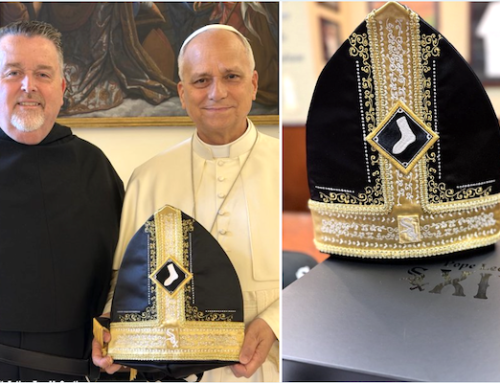
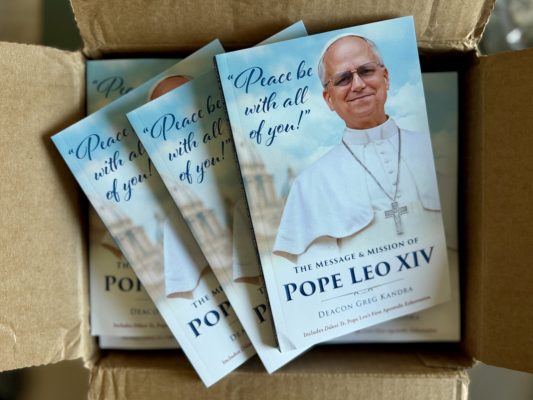
A few weeks ago, I received the first copies of my new book, “Peace Be With All of You!”: The Message and Mission of Pope Leo XIV, just published by Word Among Us Press. I’m happy today to share part of the book (which includes the full text of Dilexi Te, Pope Leo’s first Apostolic Exhortation).
The book is short and was written in the early days of the papacy; I started it in June and submitted the manuscript in September. It is far from definitive, but gives us a glimpse into some recurring themes of his life and ministry — a Pope who was (and is) a missionary, a preacher, an Augustinian and a servant.
The excerpt below looks at this last aspect of his life — one that is distinctly diaconal. Want more? You can order the book here or at Amazon. In the weeks ahead, I’ll also be offering it to folks who join my Patreon page. (Details to come!)
Merry Christmas and a Happy New Pope!
“I cannot feed you with ordinary bread, but this Word is your portion. I feed you with the same table that feeds me. I am your servant.”
— St.Augustine, quoted on the holy card for Robert Prevost’s ordination
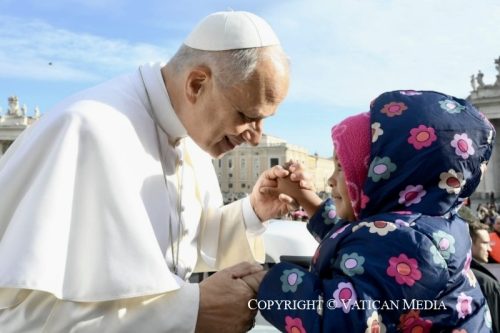
In the sixth century, Pope Gregory the Great coined a phrase to describe the humble work of the supreme pontiff: “servus servorum Dei,” the servant of the servants of God.” To this day, that phrase appears on any papal bull that is issued.
It was with that in mind that Pope Leo spoke to the College of Cardinals two days after his election as Pope:
Beginning with Saint Peter and up to myself, his unworthy Successor, the Pope has been a humble servant of God and of his brothers and sisters, and nothing more than this. It has been clearly seen in the example of so many of my Predecessors, and most recently by Pope Francis himself, with his example of complete dedication to service and to sober simplicity of life, his abandonment to God throughout his ministry and his serene trust at the moment of his return to the Father’s house. Let us take up this precious legacy and continue on the journey, inspired by the same hope that is born of faith.
This has become a prevailing theme in Leo’s messages. Several times in the early days of his papacy, Pope Leo has gone back to the theme of service and serving others, underscoring how central this is to the Christian life, and especially his papacy.
In his homily at the Mass of his installation as Pope, he said:
I come to you as a brother, who desires to be the servant of your faith and your joy, walking with you on the path of God’s love, for he wants us all to be united in one family.
In his first Regina Caeli address, on May 11, 2025, he brought it up again, this time in regard to vocations:
Let us ask our heavenly Father to assist us in living in service to one another, each according to his or her state of life, shepherds after his own heart capable of helping one another to walk in love and truth.
Unsurprisingly, this idea is deeply embedded in the heart of almost any missionary. The impulse to give, to share, to sacrifice, and to serve is intrinsic to the calling.
Long before he became pope, then-Fr. Robert Prevost reflected on this when he was Prior General of the Augustinian Order.
Speaking in Rome at a convention of the friars in 2005, he delivered an address on the subject of “servant leadership”—a phrase that originated with the AT&T executive Robert Greenleaf in the 1970s. As Fr. Prevost noted:
Greenleaf described some of the characteristics and activities of servant-leaders, providing examples which show that individual efforts, inspired by vision and a servant ethic, can make a substantial difference in the quality of society. Greenleaf said true leaders are chosen by their followers. He discussed the skills necessary to be a servant-leader; the importance of awareness, foresight and listening; and the contrasts between coercive, manipulative and persuasive power.
This style of leadership is certainly Gospel based, and in addition, there are some Augustinian insights to human experience that give a deeper appreciation for this type of leadership, a style of leadership that is needed in Augustinian communities today.
To read this speech today, two decades after it was delivered, is to get some rare insight into the thinking of the man who would be pope. It also offers us a glimpse at his own thoughts on leadership, and just maybe, his own style of leading.
It’s a style steeped, above all, in humility.
Across a text that runs a dozen pages, Fr. Prevost talks about St. Mark’s Gospel (“Whoever wishes to be the greatest among you will be your servant”), quotes St. Augustine (“We possess authority, but only if we serve”) and underscores the importance of following the example of Christ:
A true Christian leader, a true Augustinian leader, must first and foremost be a faithful follower of Christ. And Christ has shown us the way, which is one of humility. Leading in any other way runs the grave danger of going on the wrong path – making the true goal “my ideas”, “my plans”, “my personal glory”. But following Christ, who is “the way, the truth and the life” means beginning by following the footsteps of the humble Christ.
We also discover that the papacy was on his mind—but in a biblical way:
Why does Simon become “Peter”, the Rock? Jesus gives Peter his new name, not based upon the kind of “earthly power” that some might wish to possess in being given authority. Jesus asks, “Simon Peter, do you love me?” And after hearing Peter’s response, Jesus tells him, “Feed my sheep”. Once again, we return to the call of service, of being a servant of those with whom you are called to exercise “authority”. Peter is given “authority” because he has learned to love as Jesus loves; because he has learned what it means to give his life in service to others. Because Peter loved, because Peter listened to Jesus, he had a sense of “vision”, of the vision of Jesus and an understanding of where the recently born community, the Church, was gradually going.
Any effective leader must have a sense of vision. But as Augustinians, we do not necessarily have to hold the entire vision ourselves, individually. Because of our sense of community, and of looking for the presence of the Spirit in community, we can come to identify our vision precisely in and through the community. There is an interesting image, of which I was reminded on one occasion when I was presented with a gift in Papua. The gift was a wood carving of two hunters, one standing on the shoulders of another. The leader, in tum, is not necessarily the tallest person in the group. Together, in order to see where we are going, the community lifts up one person, the leader, who is then able to see, with the help of the community, where the group ought to be moving. The leader’s job then becomes to help assure that the process to get to that identified goal takes place, and in an effective manner. He knows how to promote collaboration and a true team spirit.
With clarity, precision, empathy and prayerful humility, Fr. Prevost lays out the qualities of a true “servant leader” and links all that to Augustine’s own thoughts on leadership. Here, he explains, is what the saint had to say about the ordination of a bishop:
The man, you see, who presides over the people out first of all to understand that he is the servant of many masters. And let him not disdain this role; let him not, I repeat, disdain to be the servant of many people, because the Lord of lords did not disdain to serve us. You will remember that from the dregs of the flesh a certain appetite for superiority, for being top dog, had crept in among the disciples of our Lord Jesus Christ, our apostles, and the fumes of conceit had begun to obscure their vision. As we can read in the gospel, in fact, there arose a dispute among them, about which of them was to be the greatest (Lk 9:46). The Lord, however, present as the doctor, lanced this tumor of theirs. When he saw what vice this dispute arose from, he said to them, placing small children in front of himself, Unless a person becomes like this child, he shall not enter the kingdom of heaven. What he was drawing their attention to in the child was humility.”
It becomes increasingly clear that his concern with and attention to humility is one of the defining qualities of this pope—and it something he is seeking to bring into the wider Church and, even, the world.