It sounds like such a simple question.
Who is my neighbor?
If you think you know, this Gospel says: think again.
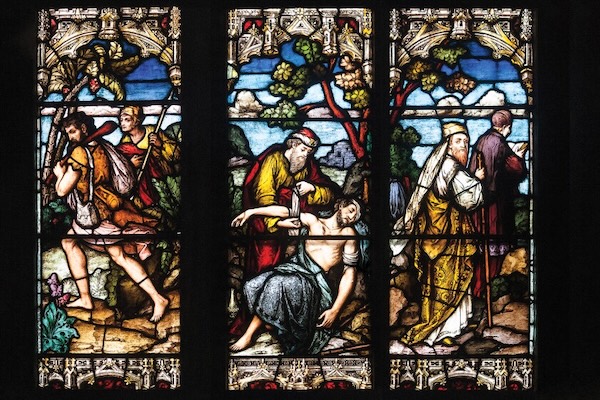
This may be one of the most familiar parables in scripture. Its title that has become a part of our language. Everyone knows what you mean by a “a good Samaritan.”
But we tend to forget: this story is revolutionary. It is shocking. It turns our expectations upside down.
You think you know who your neighbor is?
Pull up a chair. Jesus has a story for you. And some lessons, especially for our own time.
First: your neighbor isn’t just someone who shares your zip code.
Our neighborhood embraces the world. Who is my neighbor?
My neighbor is a child in Ethiopia — hungry because her country can no longer get wheat from Russia.
It is a family in Ukraine — living in a basement, while shells explode around them.
It is anyone wounded by life who feels abandoned or robbed or forgotten. It is anyone left helpless by the side of the road.
My neighbor doesn’t just live in Apopka. My neighbor lives in Kyiv. In Venezuela. In Kerry County, Texas, along the Guadalupe River.
Christ’s challenge to the people of his day is his challenge to us. It says: look beyond your circle. Widen your horizons.
I often hear people who say, “We need to take care of our own first. Don’t worry about Ukraine. We have too many of our own problems.”
When I was working for Catholic Near East Welfare Association, raising money for the poor in the Middle East, that was a refrain I heard a lot. Let’s take care of America, and then worry about everyone else.
But this parable says, “No.” It tells us, bluntly, that is not how you “love your neighbor.” Our neighborhood is the world.
The second lesson: just as your neighbor may not be who you expected, so the hero of the story may not be who you expected.
Let’s talk about Samaritans.
In Jesus’s day, the very notion of a Samaritan being “good” was unthinkable. Samaritans were heretics. If a devout Jew was traveling, he would go out of his way, even take the longest route, to avoid going through Samaria. Samaritans were people you didn’t talk to, didn’t deal with, didn’t touch. You didn’t even want to mention them by name. A friend of mine pointed out the other day something important: at the end, when Jesus asks which of the characters in his story acted as a neighbor, the scholar replied, “The one who showed mercy.”
He couldn’t even bring himself to say the word “Samaritan.”
The commentator William Barclay put it this way: when Jesus told the parable, people probably thought, “Ah, the Samaritan enters the story. He must be the villain.”
But no. It didn’t turn out that way at all.
In our own time, it’s worth asking: Who are the Samaritans of our own day? Who are the people who are hated, disrespected or shunned now?
Here’s a start: Go down the list of professions that people don’t respect. Politicians. Lawyers. Journalists.
As someone who spent most of my life in television news, I’m trying to imagine the parable of The Good Journalist.
How about the parable of The Good Democrat? The Good Republican? The Good Refugee?
One of the lessons here for our own divided, polarized time is that the potential for goodness — for following God’s commandments, for living with a heart of compassion and mercy and love — lies within all of us. Even Samaritans can be good.
Sometimes, those we consider Samaritans can be saints.
Last Wednesday, July 9, was the feast of Saint Mark Ji Tianxiang, a Chinese lay Catholic and doctor.
He was also a drug addict.
Mark Ji suffered from a debilitating stomach ailment. While trying to treat it, he became addicted to opium. It became his cross. He went to confession regularly to confess his drug use. But his confessor didn’t understand addiction — and after time, he refused to give absolution, because he believed Mark Ji didn’t really want to change his life. But Mark Ji never lost hope. Although he couldn’t receive the sacraments, he continued going to Mass. He stayed steadfast in his faith for 30 years. During the Boxer Rebellion, at a time of Christian persecution, he and his family were imprisoned. Through it all, he encouraged his fellow Christians to keep their faith. Eventually, he and his family were sentenced to death. As he was about to be beheaded, Mark Ji sang the litany of the Blessed Virgin Mary. “Queen of confessors, pray for us, Queen of virgins, pray for us, Queen of all saints, pray for us…” Mark Ji was martyred on July 7, 1900. A century later, in 2000, Pope John Paul canonized him.
A priest saw Mark Ji Tianxiang as a habitual sinner. But he was a saint.
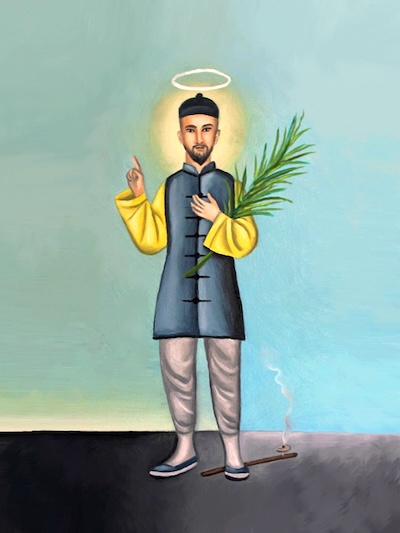
Sometimes, Samaritans are saints.
Pope Benedict took it a step further, writing: “Many Fathers of the Church saw Jesus himself in the Good Samaritan — the one who makes present the Father’s love, a love which is faithful, eternal and without boundaries.”
Of course, it’s worth remembering: Jesus was himself a rejected figure who brought healing to a broken, bleeding world.
Finally, the most challenging lesson: “Go and do likewise.”
I think these last four words of the parable are among the most difficult in all of scripture.
Too often, we just don’t want to get involved.
But Jesus is telling us all: Get involved.
The road between Jerusalem and Jericho is the road all of us travel. It is the journey of life. Difficult. At times, even dangerous. Thieves wait for all of us.
What do we do about those who have been victimized, beaten and forgotten?
That question goes beyond the physical reality in this parable.
Spend any time watching cable TV or scrolling through social media and you probably won’t see many people loving their neighbors. Quite the opposite.
But this Gospel says there is another way.
A way that gives dignity. And respect. And hope.
This is what we are meant to do. Our call as Christians also calls us to remember this: everyone is made in the image and likeness of God. So, live these commandments. Love God. Love your neighbor. Be people of mercy, always. At home. At work. In the world.
“Go and do likewise.”
We are meant to be more than just people traveling the road.
Christ wants us to be like the Samaritan.
Because, in doing that, we not only fulfill the second great commandment.
We actually become more like Christ.