
More than a few people noticed that the funeral for Jimmy Carter included a rendition of John Lennon’s “Imagine” — and not everybody loved it.
On Twitter, Bishop Robert Barron had this reaction:
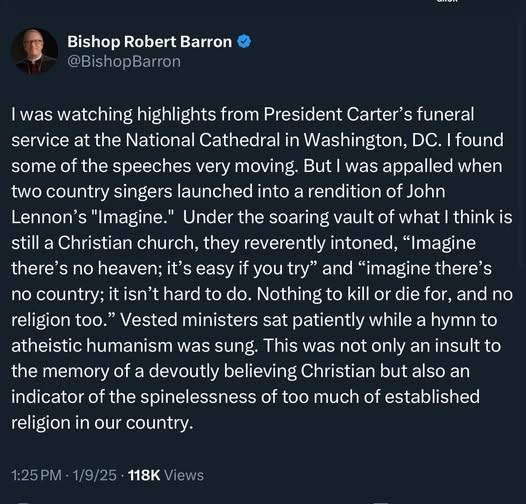
There seems little doubt that Carter — a devoted and very public Christian — wanted the song included in his funeral, which is something most Catholic churches wouldn’t countenance.
But the song has a powerful grip on the popular imagination (so to speak) and resonates with many. I wondered if Lennon himself had ever addressed how the song treats religion.
I found this:
‘Imagine’ is undisputedly Lennon’s most widely revered track from his post-Beatles career but, in truth, the song feels as though it no longer belongs to him due to the plethora of different ways it has been interpreted over the last half a century. The song’s legacy was perfectly summarised by President Jimmy Carter, who noted: “In many countries around the world — my wife and I have visited about 125 countries — you hear John Lennon’s song ‘Imagine’ used almost equally with national anthems.”
In an interview with David Sheff for Playboy Magazine, shortly before his death in December 1980, Lennon shared that Dick Gregory had given him and Ono a Christian Prayer-book which had inspired him to write the track. “The concept of positive prayer…If you can imagine a world at peace, with no denominations of religion – not without religion but without this my God-is-bigger-than-your-God thing – then it can be true.”
The Beatle continued, “The World Church called me once and asked, ‘Can we use the lyrics to ‘Imagine’ and just change it to ‘Imagine one religion’?’ That showed [me] they didn’t understand it at all. It would defeat the whole purpose of the song, the whole idea.”
Despite the concept of unity that Lennon touched on with David Sheff, the song was also inspired by the communist movement. Lennon later confirmed that the similarities between his ideals set out in the song and Communism were indeed deliberate: “‘Imagine’, which says: ‘Imagine that there was no more religion, no more country, no more politics,’ is virtually the Communist Manifesto, even though I’m not particularly a Communist and I do not belong to any movement.”
Elsewhere, Lennon has given credit to Yoko Ono’s poetry for the inspiration:
Several poems from Yoko Ono‘s 1964 book Grapefruit inspired Lennon to write the lyrics for “Imagine”—in particular, one which Capitol Records reproduced on the back cover of the original Imagine LP titled “Cloud Piece”, reads: “Imagine the clouds dripping, dig a hole in your garden to put them in.” Lennon later said the composition “should be credited as a Lennon/Ono song. A lot of it—the lyric and the concept—came from Yoko, but in those days I was a bit more selfish, a bit more macho, and I sort of omitted her contribution, but it was right out of Grapefruit.”
As for the song’s legacy:
Rolling Stone ranked “Imagine” number three on its list of “The 500 Greatest Songs of All Time“, describing it as “an enduring hymn of solace and promise that has carried us through extreme grief, from the shock of Lennon’s own death in 1980 to the unspeakable horror of September 11. It is now impossible to imagine a world without ‘Imagine’, and we need it more than he ever dreamed.”Despite that sentiment, Clear Channel Communications (now known today as iHeartMedia) included the song on its post-9/11 “do not play” list.
Former Beatle Ringo Starr defended the song’s lyrics during a 1981 interview with Barbara Walters, stating: “[Lennon] said ‘imagine’, that’s all. Just imagine it.”
Perhaps unsurprisingly, Lennon himself struggled with ideas of God, faith and belief:
While “Imagine” can certainly be seen as atheistic, Lennon professed a belief in an afterlife and God. In a 1965 interview, Lennon and the other three Beatles had collectively referred to themselves as agnostic. Lennon continued to grapple with his spirituality and looked into various religions, maybe never more fervently than while struggling to kick a heroin addiction in the early ’70s. At one point, he may have even considered himself a born-again Christian, though for no more than a couple of weeks. He would, however, express certain clear religious beliefs, once stating: “I believe in God but not as one thing, not as an old man in the sky. I believe that what people call God is something in all of us.” In other words, Lennon’s personal view of God was akin to what Jesus was referring to when he said, “The Kingdom of God is within you.”
Meanwhile, speaking of funeral music: I’m reminded of this curious fact. Just a decade ago, the BBC reported that the most requested funeral song in Great Britain was “Always Look on the Bright Side of Life” from Monty Python:
Monty Python’s Always Look On The Bright Side Of Life has become the most popular tune to play at a UK funeral.
A study by a chain of funeral directors found the 1979 Life of Brian song had overtaken Frank Sinatra’s My Way as the preferred choice of music.
David Collingwood, of The Co-operative Funeralcare, suggested the findings represented “a generational shift in attitudes towards funerals”.
“Modern funerals are very much about personal choice,” he added.
“The variety of songs played at funerals today illustrates how more and more people are choosing to personalise funerals, and celebrate their loved one’s life with a fitting farewell.”
Monty Python’s irreverent song – which Eric Idle sang at the closing ceremony of the 2012 Olympic Games in London – rose from 13th place three years ago, to become the most popular funeral song this year.
“We wonder if it’s the people who were young in the swinging ’60s, who are now in their 70s and 80s, and if that’s informing this trend,” a spokesman told the Telegraph, external.