


From Catholic Extension:
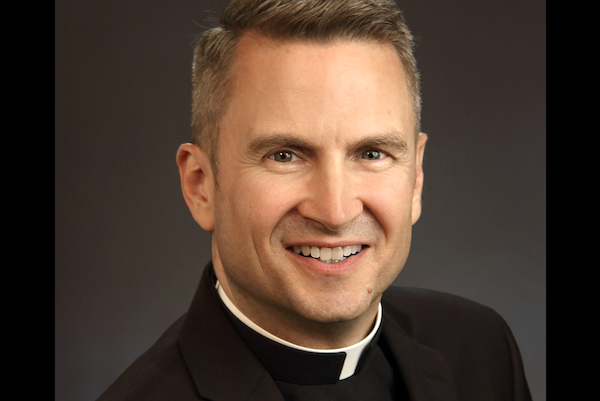
For the February 6 installation Mass in Manhattan’s historic St. Patrick’s Cathedral, an event attended by donors, dignitaries, and church leaders, the new archbishop of New York, Most Reverend Ronald Hicks, made the touching choice to invite a young man and former orphan named Samuel Jimenez to read the scripture at Mass.
At a press conference on February 5, Hicks said “I chose him specifically.”
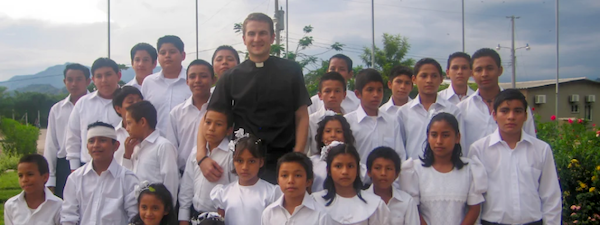
Jimenez is an immigrant to the United States, and was once a resident in the El Salvador orphanage, Nuestros Pequeños Hermanos (“Our Little Brothers and Sisters”), that then-Father Hicks led from 2005 through 2009.
A book was written on Jimenez’s life “Do not Discard,” describing his amazing story of survival—beginning as an infant when he was literally disposed of in a trash dump before being rescued by strangers. He was then shot by bandits as a young child and violently abused by his adoptive parents, all before ending up at the orphanage Most Reverend Hicks led.
By bringing the one-time orphan to read at his installation Mass, the new archbishop’s message was clear: People like Jimenez are the kind of souls who should always be at the heart of the Church, not the periphery.
While Father Hicks left the orphanage in 2009 to return to ministry in his home Archdiocese of Chicago, ultimately being ordained a bishop in 2018, his heart nonetheless remained with the orphaned and neglected he served. Most Reverend Hicks acknowledges that serving in Latin America—first as a seminarian in in Mexico and later as a priest in El Salvador—were experiences that transformed his life, saying in Spanish:“The reason I picked (Sam) was because he is part of my life of that mission that I had in Central America. I left my heart in Central America. He represents a part of my life that is family; affection that is love.”

The next Archbishop of New York also laid out his vision for the archdiocese.
From NCR:
Hicks described that mission in distinctly outward-looking terms. “I’m going to talk just about being a church who’s made up of missionary disciples who want to go out and make disciples, and also to pass our faith on to the next generations,” he said. “We’re going to talk about a church that builds bridges, goes out to the peripheries, engages the world and lives her mission — a missionary church.”
The liturgies themselves will reflect that outlook, including bilingual elements. Drawing on three decades of priesthood in which the Hispanic community has been central to his ministry, Hicks said he intentionally preaches partly in Spanish.
“I want to communicate to the world that the Hispanic community is very important in the life of the Catholic Church, and it is also a way to show my respect, dignity and love for the Latin community,” he said.
Hicks also emphasized the breadth of people who will be present at the celebrations. Alongside Catholic clergy and laity will be representatives from other faith traditions, government, business, labor, education, service organizations, first responders and the arts.
“In other words, who’s going to be there? Everyone. Everyone,” he said. “To quote Pope Francis, when he would say, who’s going to be there, todos, todos, todos. This is good, because New York is a place where the whole world lives and calls home, and the Catholic Church is universal, gathering and engaging everyone.”
Asked by the National Catholic Reporter about his message to immigrant Catholics whose voices are struggling to be heard nationally, Hicks framed his response in Catholic social teaching.
“My response comes from a clear understanding in the Catholic Church and our social justice of what is human dignity,” he said. “My message is: How do we treat each other with respect? How simply do we see each other as brothers and sisters and use that as a foundation for everything?”
Hicks likewise spoke about bridging divides between rich and poor in a city marked by stark contrasts.
“I think that’s the power of Jesus. He loves, knows and reaches out to everyone, everyone, and He wants everyone to be saved,” he said.